“If You Count the Blessings of Allah”: The Verse and What It Means
By Mustafa Ali
In short
The sentence appears twice in the Quran: in Surah Ibrahim 14:34 and in Surah an-Nahl 16:18. Both say that if you tried to count the favors of Allah, you could not list them all. The first verse ends with human ingratitude, the second with Allah’s forgiveness and mercy.
“And if you should count the favors of Allāh, you could not enumerate them” is in the Quran twice: Surah Ibrahim 14:34 and Surah an-Nahl 16:18. It says that the blessings of Allah are more than a person can list. In both surahs it comes right after verses that name examples, such as rain, fruits, ships, the sun and the moon, and night and day.
Get Ni’mah on the App Store
Where is the verse in the Quran?
You will find the sentence in two surahs. The wording is almost the same. The endings are different.
And He gave you from all you asked of Him. And if you should count the favor [i.e., blessings] of Allāh, you could not enumerate them. Indeed, mankind is [generally] most unjust and ungrateful.
And if you should count the favors of Allāh, you could not enumerate them. Indeed, Allāh is Forgiving and Merciful.
| Part of the verse | Surah Ibrahim 14:34 | Surah an-Nahl 16:18 |
|---|---|---|
| How the verse begins | “And He gave you from all you asked of Him.” | It begins directly with the sentence about counting. |
| The shared sentence | “And if you should count the favor [i.e., blessings] of Allāh, you could not enumerate them.” | “And if you should count the favors of Allāh, you could not enumerate them.” |
| How the verse ends | “Indeed, mankind is [generally] most unjust and ungrateful.” | “Indeed, Allāh is Forgiving and Merciful.” |
What differs in the two endings
The first ending describes people. After everything that has been given, the verse says that mankind is most unjust and ungrateful.
The second ending describes Allah. After the same sentence about blessings that cannot be counted, the verse says that He is Forgiving and Merciful.
Read side by side, the two verses hold up two things at once: how easily we overlook what we have been given, and that Allah is forgiving and merciful toward the people who receive it.
The examples just before the verse
In both surahs the sentence does not stand alone. The verses before it give a list of examples, and the sentence about counting comes after that list.
In Surah Ibrahim, the two verses before 14:34 name the heavens and the earth, rain, fruits, ships and rivers, then the sun and the moon and the night and the day.
It is Allāh who created the heavens and the earth and sent down rain from the sky and produced thereby some fruits as provision for you and subjected for you the ships to sail through the sea by His command and subjected for you the rivers.
And He subjected for you the sun and the moon, continuous [in orbit], and subjected for you the night and the day.
In Surah an-Nahl, the verses shortly before 16:18 name the sea, then mountains, rivers and roads, landmarks and the stars people are guided by (16:14–16).
And it is He who subjected the sea for you to eat from it tender meat and to extract from it ornaments which you wear. And you see the ships plowing through it, and [He subjected it] that you may seek of His bounty; and perhaps you will be grateful.
Notice what kind of examples these are. They are not rare events. They are things that are there every day: water, food, daylight, sleep at night, a road that takes you home.
What the verse means for you
The verse does not say “do not count”. It says that if you did, you could not finish. That takes pressure off. You are not asked for a complete list. You are asked to see.
Surah an-Nahl 16:14 also shows what the examples are for. It ends with the words “and perhaps you will be grateful.” The list of blessings leads to gratitude.
How to notice blessings day to day
You cannot count them all, but you can notice a few each day. These steps take a few minutes.
Start with what is always there.
The verses before 14:34 and 16:18 name rain, fruits, the sun, the night and the day. Pick one ordinary thing from your own day, like clean water or a quiet night, and look at it as a gift.
Say “Alhamdulillah” when you eat and drink.
Meals come several times a day, so they are an easy reminder. The hadith below connects praising Allah to a bite of food and a sip of drink.
Look at those who have less.
When you catch yourself comparing with someone who has more, turn your eyes the other way. The second hadith below gives exactly this advice.
Write three blessings down.
In the evening, write three specific things from today. “My daughter helped me set the table” is better than “my family”.
Read back once a week.
On Friday or at the weekend, read the last seven days. You will see blessings you had already forgotten.
The Prophet ﷺ said that Allah is pleased with a servant who eats a bite of food and praises Him for it, or takes a drink and praises Him for it.
The Prophet ﷺ said that when one of you looks at someone who has been given more than him in wealth and physical form, he should look at someone who is below him in these things.
Where to keep your list
For the fourth step you need somewhere to write. A notebook works and so does an app. Choose the one you will actually open every day.
Ni’mah is a Muslim gratitude journal for iPhone that we built for Muslim families. You write down what you are grateful for each day, and a reminder helps you keep the habit. Your memories are stored on your iPhone and, with iCloud sync, in your private iCloud. If you like, a photo becomes an illustration in which faces are not recognizable.
Without a subscription, the gratitude journal, reminders, Love Notes, widgets and 1 illustration per month are included. Ni’mah Pro gives you a larger illustration allowance.
Ni’mah is our own app.
Download Ni’mah on the App Store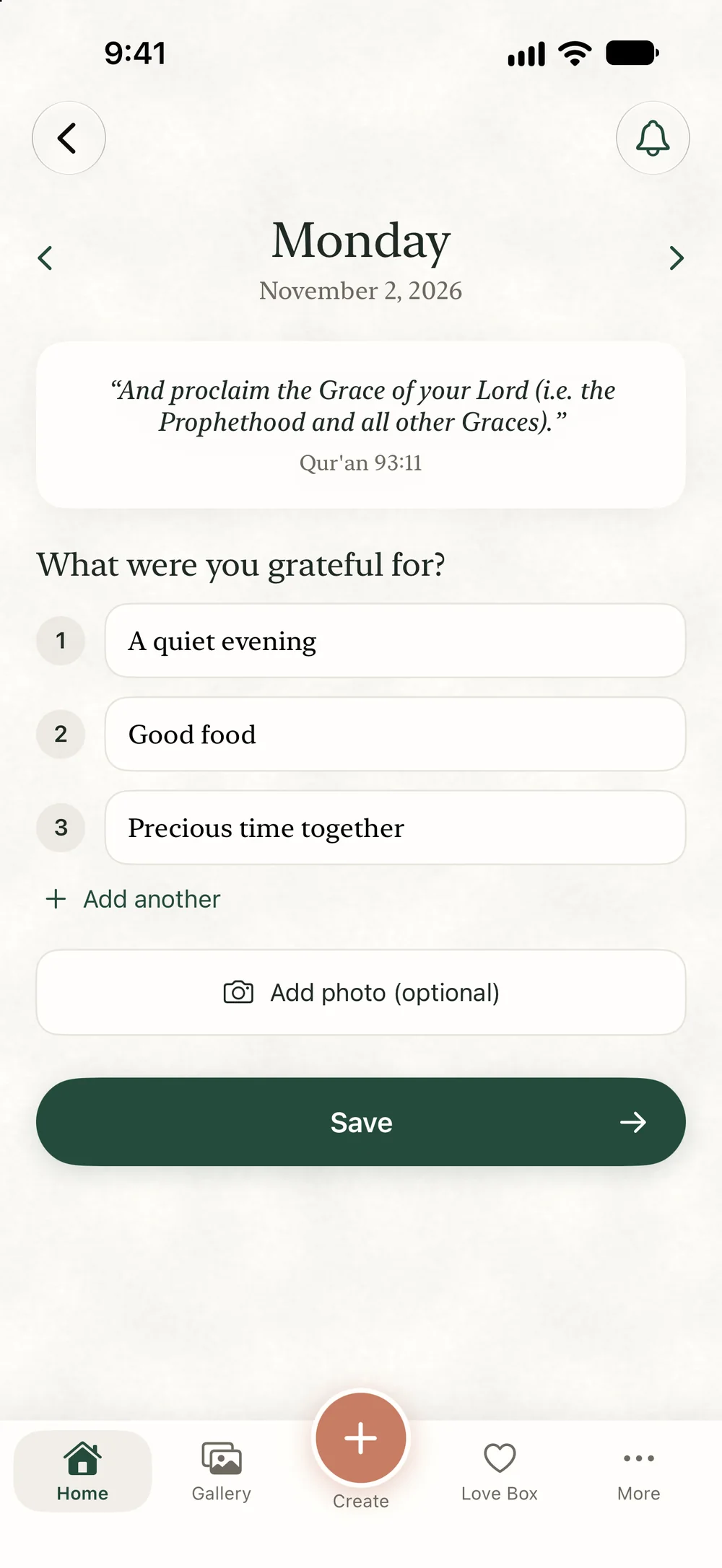
Start with three
You will never finish the list, and the verse says so. Tonight, write down three blessings from today and say “Alhamdulillah” for each. Do the same tomorrow.
Write your blessings in Ni’mahFrequently asked questions
- Which surah says “if you count the blessings of Allah”?
- Two surahs: Surah Ibrahim 14:34 and Surah an-Nahl 16:18. In the Saheeh International translation, 16:18 reads: “And if you should count the favors of Allāh, you could not enumerate them. Indeed, Allāh is Forgiving and Merciful.”
- What is the difference between 14:34 and 16:18?
- The sentence about counting is nearly the same. Surah Ibrahim 14:34 begins with “And He gave you from all you asked of Him” and ends with “Indeed, mankind is [generally] most unjust and ungrateful.” Surah an-Nahl 16:18 ends with “Indeed, Allāh is Forgiving and Merciful.”
- Which blessings are named before the verse?
- Before 14:34: the heavens and the earth, rain, fruits, ships, rivers, the sun, the moon, the night and the day (14:32–33). Before 16:18, among others: the sea, mountains, rivers, roads, landmarks and the stars (16:14–16).
- Does the verse mean I should not count my blessings?
- The verse does not forbid it. It says that if you counted, you could not enumerate them all. Writing down a few blessings each day is a way to notice some of them, not a full list.
- What should I say after eating and drinking?
- Praise Allah, for example with “Alhamdulillah”. The Prophet ﷺ said that Allah is pleased with a servant who praises Him for a bite of food or a drink (in meaning: Muslim, no. 2734a).
- Is Ni’mah free?
- Yes, Ni’mah can be used without a subscription: the gratitude journal, reminders, Love Notes, widgets and 1 illustration per month are included. Ni’mah Pro offers a larger illustration allowance; with the yearly plan, two people can use Ni’mah Together.
Sources
- Surah Ibrahim 14:32, Saheeh International (quran.com)
- Surah Ibrahim 14:33, Saheeh International (quran.com)
- Surah Ibrahim 14:34, Saheeh International (quran.com)
- Surah an-Nahl 16:14, Saheeh International (quran.com)
- Surah an-Nahl 16:15, Saheeh International (quran.com)
- Surah an-Nahl 16:16, Saheeh International (quran.com)
- Surah an-Nahl 16:18, Saheeh International (quran.com)
- Sahih Muslim, no. 2734a (sunnah.com)
- Sahih Muslim, no. 2963a (sunnah.com)
Read also
Related guides
- How to Keep the Blessings Allah Gave You
What the Qur’an says about keeping and losing blessings: 14:7, 8:53, the town in 16:112 and Saba’, plus a dua from Sahih Muslim and five daily habits.
- Ni’mah Meaning: What Does Ni‘mah (نعمة) Mean in Islam?
Ni‘mah (نعمة) means blessing, favor or gift. What the Quran says about the blessings of Allah: where they come from, their kinds and how to respond.
- The Health and Free Time Hadith: Two Blessings Many People Lose Out On
The hadith about two blessings many people lose out on, health and free time: its wording, related hadiths and verses, and small ways to use both well.
- “Which of the Favors of Your Lord Will You Deny?” Meaning of Surah ar-Rahman 55:13
Surah ar-Rahman 55:13 in Arabic, transliteration and English: what the verse means, how often it is repeated, who “you both” are and how to answer it.
About the author
Mustafa Ali
Mustafa Ali lives in Medina, the City of the Prophet ﷺ, where he studies Islamic sciences. He built Ni’mah as an Islamic photo app that shows no faces, so families can keep their memories without exposing them to the evil eye and envy.