Couples Gratitude Journal: How to Start, With 40 Prompts
By Mustafa Ali
In short
A couples gratitude journal is a place where husband and wife write down what they are grateful for in each other and in their life together. Each of you writes one line in the evening, and once a week you read your lines to each other. Below are five steps and 40 prompts to start with.
In a couples gratitude journal, each spouse regularly writes down something they are thankful for: something the other did, a moment you shared, a blessing in your home. Then you tell each other. The Qur’an calls the affection and mercy between spouses one of the signs of Allah (30:21), and a journal is a simple way to notice that sign on ordinary days. Start small: one line each in the evening, read aloud once a week.
Get Ni’mah on the App Store
What is a couples gratitude journal?
A couples journal is a journal that two people keep about their life together. A couples gratitude journal narrows it to one question: what am I thankful for today, in you and in us? It is not a place for complaints or for settling an argument. It is where the good things get written down before they are forgotten.
There are two common ways to keep one. Both work, and you can switch at any time.
| Format | How it works | Good for |
|---|---|---|
| One shared notebook | The notebook lies somewhere you both pass, for example on the nightstand. Each of you adds a line when you can, and the other reads it. | Couples who like to read each other’s lines during the week. |
| Two journals, shared once a week | Each of you keeps your own journal. Once a week you read one or two entries to each other, or send one as a short note. | Couples with different routines, or when one of you prefers to write privately. |
Gratitude between spouses in the Qur’an and Sunnah
Neither the Qur’an nor the Sunnah prescribes a journal. It is a tool. But the Qur’an describes marriage in words that are worth writing at the front of one:
And of His signs is that He created for you from yourselves mates that you may find tranquility in them; and He placed between you affection and mercy. Indeed in that are signs for a people who give thought.
The verse ends with “a people who give thought”. A few written lines in the evening are one way of giving thought to what is already there: the tranquility, the affection and the mercy in your home.
And [remember] when your Lord proclaimed, ‘If you are grateful, I will surely increase you [in favor]; but if you deny, indeed, My punishment is severe.’
Many of the blessings in a marriage reach you through your spouse: a meal, a kind word, a night with the baby so that you could sleep. The Sunnah ties thanking that person to thanking Allah:
The Prophet ﷺ said that whoever is not grateful to people is not grateful to Allah.
How to start a couples gratitude journal
Agree on a format and a time.
One notebook or two journals, and a fixed moment that already exists in your day: after Isha, after the children are asleep, with the evening tea.
Write one line each.
One thing you are grateful for today, with the reason. “You warmed up the car before I left, so I started the day calm” says more than “thank you for everything”.
Use a prompt when nothing comes to mind.
Pick one question from the list below. You can both answer the same one or each choose your own.
Read to each other once a week.
Choose a quiet time, for example Friday evening. Each of you reads two or three lines aloud. Listen without commenting or correcting.
Close with a dua.
End by saying Alhamdulillah and making a short dua for each other. The dua from Surah al-Furqan further down this page is a good one to learn together.
If only one of you wants to write
Start alone. Write your own lines about your spouse and tell them one of them every now and then. A journal does not need two writers to do its job; one person noticing the good is already a change in the home.
40 couples journal prompts
Eight prompts each in five groups. They are our own wording and meant as starting points. Skip any that does not fit your marriage.
Thank you for today
- What did your spouse do today that made your day easier?
- Which small thing did they do today that they probably think you did not notice?
- What did they say today that you want to remember?
- What did they take off your hands this week?
- When did you feel looked after today?
- What did you eat, wear or use today because your spouse thought of it?
- What did they do for someone else today that made you proud?
- If you could thank them for only one thing from today, what would it be?
What I see in you
- Which quality of your spouse do you rely on most?
- What do they do better than you, and how does it help you both?
- Which habit of theirs did you find strange at first and would now miss?
- When did you last see them be patient when it was not easy?
- What have you learned from the way they pray, give or treat their parents?
- What makes them laugh, and when did you last hear it?
- What are they working hard on right now, even if nobody praises it?
- What would you tell their mother or father about them?
Our life together
- Which ordinary moment of this week would you like to keep?
- What do you have in your home today that you once made dua for?
- Which meal did you share this week, and what did you talk about?
- What does your home sound like on a good evening?
- Which decision that you made together are you glad about today?
- What is one thing you only do as a couple and with nobody else?
- What did your first home look like, and what do you remember fondly about it?
- Which blessing in your marriage have you stopped noticing because it is there every day?
Hard days
- What was heavy this week, and how did your spouse carry part of it?
- Which difficulty did you get through together that you once thought you could not?
- What did they do the last time you were ill or exhausted?
- What would you like to thank them for that you forgot to say during a stressful time?
- After your last disagreement, what helped you find your way back?
- What is still good in your home on a day when a lot is going wrong?
- What did they give up so that you could have something?
- Which worry of yours became smaller once you had told them?
Duas and hopes
- What will you ask Allah for your spouse tonight?
- Which dua have the two of you been making for a long time?
- What do you hope an ordinary Friday looks like for you both in five years?
- Which act of worship would you like to do together more often?
- What would you like to learn together before next Ramadan?
- What can you do tomorrow to make their day easier?
- Which good deed would you like to start as a couple?
- What do you want your children, or the people around you, to learn from your marriage?
Example entries
An entry does not need to be long. One blessing and one reason are enough.
| What I am grateful for | Why |
|---|---|
| You got up with the baby at four. | I slept three hours in a row and was a kinder person all day. |
| You called my mother without me asking. | She told me about it twice. It meant a lot to her, and to me. |
| We prayed Maghrib together before dinner. | The evening felt slower and calmer after that. |
| You listened when I talked about work. | You did not try to solve it, and that was what I needed. |
Say it out loud: Jazak Allahu khayran
A line in a journal is a start. It is complete when the other person hears it. The Sunnah gives a short phrase for thanking someone:
جَزَاكَ اللَّهُ خَيْرًا
Jazak Allahu khayran.
May Allah reward you with good.
The Prophet ﷺ said that whoever has good done to them and says to the one who did it “May Allah reward you with good” has done the utmost in praise.
The form above is addressed to a man. When you say it to a woman, the first word becomes “jazaki”.
A dua for the two of you
The Qur’an describes the servants of the Most Merciful as people who make this dua. It uses the same Arabic word, azwaj, that 30:21 uses for the mates Allah created for you.
رَبَّنَا هَبْ لَنَا مِنْ أَزْوَٰجِنَا وَذُرِّيَّـٰتِنَا قُرَّةَ أَعْيُنٍ وَٱجْعَلْنَا لِلْمُتَّقِينَ إِمَامًا
Rabbana hab lana min azwajina wa dhurriyyatina qurrata a‘yunin waj‘alna lil-muttaqina imama.
Our Lord, grant us from among our wives and offspring comfort to our eyes and make us a leader [i.e., example] for the righteous.
Notebook or app?
A shared notebook on the nightstand is all you need. An app is more practical when your routines differ or one of you travels: each of you writes on your own phone, and a reminder keeps the habit going.
Ni’mah is a Muslim gratitude journal for iPhone that we built for Muslim families. Each spouse keeps their own journal, and it stays private. To share a line, you send it as a Love Note: a few words for the people you love, which land in their Love Box.
Without a subscription, the gratitude journal, reminders, Love Notes, widgets and 1 illustration per month are included. With the yearly Ni’mah Pro plan, two people can use Ni’mah Together: you invite your spouse with a code and share one illustration allowance. Your journals, memories and Love Boxes stay separate; only the cards you send are shared.
Ni’mah is our own app.
Download Ni’mah on the App Store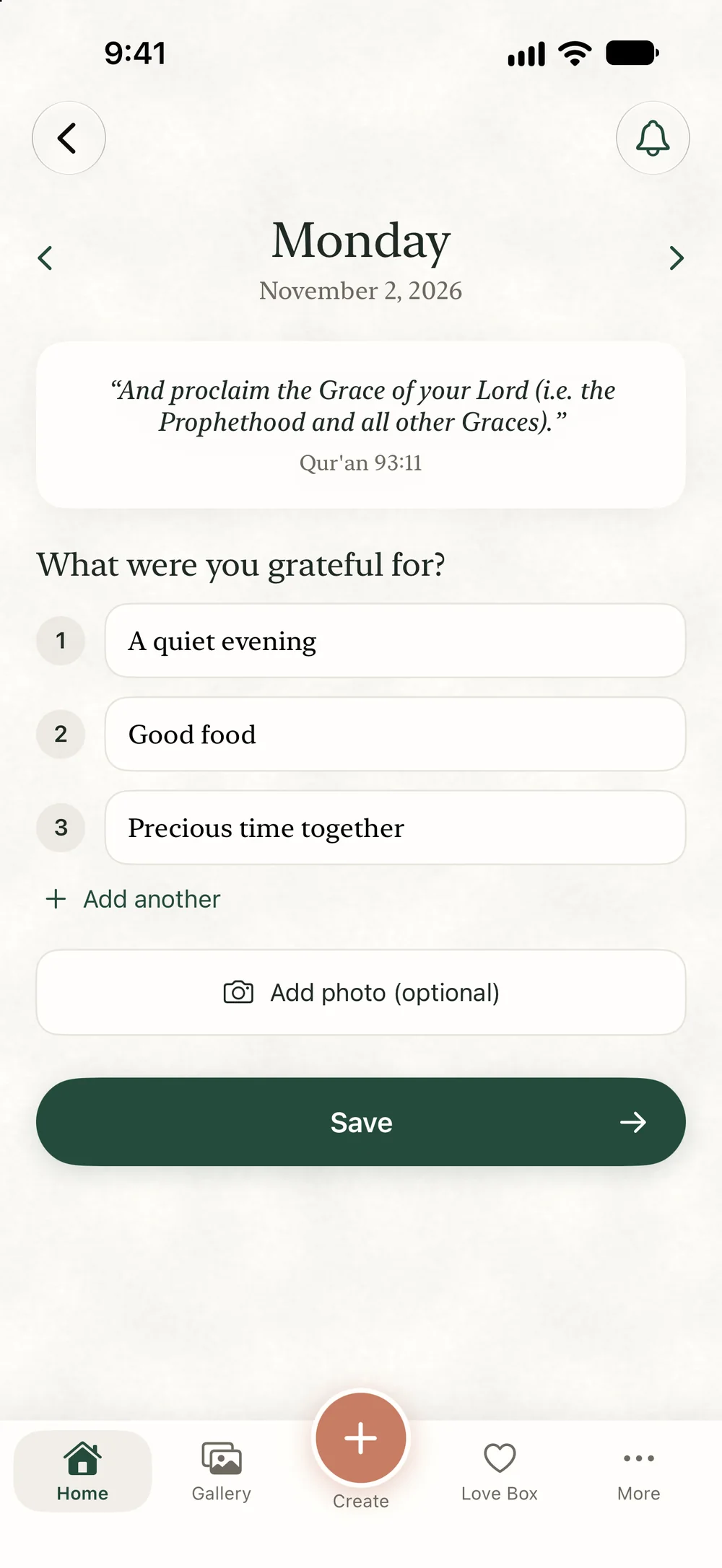
Write one line tonight
Pick one prompt, write down one thing you are grateful for in your spouse, and tell them. Tomorrow, do it again.
Start your journal in Ni’mahFrequently asked questions
- What is a couples gratitude journal?
- A journal in which two spouses write down what they are grateful for in each other and in their life together, and then share it. It can be one shared notebook or two separate journals that you read to each other once a week.
- What do you write in a couples journal?
- Something specific the other person did, a moment you shared, a blessing in your home, a difficulty you got through together and the duas you make for each other. The 40 couples journal prompts on this page cover these five areas.
- How often should we write?
- One line each on most evenings and a few minutes of reading to each other once a week is a realistic start. A short entry written regularly is more useful than a long one once a month.
- What if my spouse does not want to journal?
- Start on your own. Write your lines about your spouse and tell them one from time to time, or send it as a short note. Do not make it a duty for the other person.
- Is there a dua for husband and wife in the Qur’an?
- Surah al-Furqan 25:74 contains the dua “Our Lord, grant us from among our wives and offspring comfort to our eyes and make us a leader [i.e., example] for the righteous” (Saheeh International). The Arabic text and transliteration are on this page.
- Can my spouse read my journal in Ni’mah?
- No. Your journal, memories and Love Box stay private, also with Ni’mah Together. Only the cards you send are shared. Ni’mah Together is part of the yearly Ni’mah Pro plan and connects two people with an invitation code.
Sources
- Surah ar-Rum 30:21, Saheeh International (quran.com)
- Surah Ibrahim 14:7, Saheeh International (quran.com)
- Surah al-Furqan 25:74, Saheeh International (quran.com)
- Jami‘ at-Tirmidhi, no. 1954 (sunnah.com)
- Jami‘ at-Tirmidhi, no. 2035 (sunnah.com)
Read also
Related guides
- Duas for Protection in Islam: Morning, Evening and Before Sleep
Duas for protection from the Quran and Sunnah in Arabic with transliteration and meaning: Ayat al-Kursi, the three Quls and the Prophet’s ﷺ daily adhkar.
- Evil Eye (Ayn) and Hasad: What Is the Difference?
Evil eye (ayn) and hasad (envy) are related but not the same. What each means in Islam, what the Quran and hadith say, and how to seek protection.
- Hasad (Envy) in Islam: Meaning, Protection and What to Do About It
What hasad means in Islam, what the Quran and hadith say about envy, how to protect yourself from an envier and what to do when you feel envy yourself.
About the author
Mustafa Ali
Mustafa Ali lives in Medina, the City of the Prophet ﷺ, where he studies Islamic sciences. He built Ni’mah as an Islamic photo app that shows no faces, so families can keep their memories without exposing them to the evil eye and envy.