Ni’mah Meaning: What Does Ni‘mah (نعمة) Mean in Islam?
By Mustafa Ali
In short
Ni‘mah (نعمة) is the Arabic word for a blessing, favor or gift; the plural is ni‘am. The Quran says that every favor you have is from Allah (16:53), that His favors are apparent and unapparent (31:20) and that you could not count them (14:34). The response it asks for is gratitude (14:7).
Ni‘mah (نعمة) is an Arabic word that means blessing, favor or gift. The plural is ni‘am. In the Quran the word is used for what Allah gives to people: “And whatever you have of favor - it is from Allāh” (16:53). The Quran also says that these favors cannot be counted and that the right response to them is gratitude.
Get Ni’mah on the App Store
The word ni‘mah
Ni‘mah is written نعمة in Arabic. It is a single blessing, favor or gift. When you speak of many, the plural is ni‘am.
In English you will see the word spelled in several ways: ni‘mah, ni’mah or nimah. They all point to the same Arabic word. In the verses quoted on this page, from the Saheeh International translation of the Quran, it is translated as “favor”.
The verses below show how the Quran uses the word. Each one adds one point: where blessings come from, what kinds there are, how many there are and what to do with them.
Every blessing comes from Allah
The first point is the source. The Quran does not divide your life into things that come from Allah and things that come from somewhere else.
And whatever you have of favor - it is from Allāh. Then when adversity touches you, to Him you cry for help.
“Whatever you have” is a wide phrase. It covers the meal on your table, the people you love and the health you woke up with. The second half of the verse adds something honest about people: in hardship we turn to Allah quickly. The first half asks you to remember Him in ease as well.
Apparent and hidden blessings
The second point is that not every blessing is easy to see. In Surah Luqman the plural form is used, and two kinds are named.
Do you not see that Allāh has made subject to you whatever is in the heavens and whatever is in the earth and amply bestowed upon you His favors, [both] apparent and unapparent?
The verse does not list which favors are apparent and which are unapparent. For your own reflection, it is enough to notice that there are both: blessings you can point to, and blessings you only notice when you stop and think.
Blessings cannot be counted
The third point is the number. The Quran says it plainly, in two places: Surah Ibrahim 14:34 and Surah an-Nahl 16:18.
And He gave you from all you asked of Him. And if you should count the favor [i.e., blessings] of Allāh, you could not enumerate them. Indeed, mankind is [generally] most unjust and ungrateful.
Surah an-Nahl repeats the sentence and closes it differently:
And if you should count the favors of Allāh, you could not enumerate them. Indeed, Allāh is Forgiving and Merciful.
One verse ends with how ungrateful people can be. The other ends with Allah’s forgiveness and mercy. Both begin from the same fact: there are more blessings in your life than you could ever write down.
The verse does not tell you to stop counting. It tells you that you would never reach the end. A list of three blessings in the evening is not the full list. It is a way to notice a few of them.
“Report the favor of your Lord”
The fourth point is that a blessing is meant to be mentioned. Surah ad-Duha closes with this short verse:
But as for the favor of your Lord, report [it].
Saying “Alhamdulillah” out loud, telling your family what went well today and writing a blessing down are simple ways to put it into words.
The completed favor
The word ni‘mah is not only used for food, health and family. In Surah al-Ma’idah it is used for the religion itself.
This day I have perfected for you your religion and completed My favor upon you and have approved for you Islām as religion.
So when you think about your blessings, guidance belongs on the list: knowing how to pray, having the Quran to read and being able to say “Alhamdulillah” at all.
Kinds of blessings named in these verses
Here are the verses from this page side by side.
| What the verse names | Verse |
|---|---|
| Whatever you have of favor | Surah an-Nahl 16:53 |
| Whatever is in the heavens and in the earth, made subject to you | Surah Luqman 31:20 |
| Apparent favors and unapparent favors | Surah Luqman 31:20 |
| Being given from all you asked of Him | Surah Ibrahim 14:34 |
| The religion, perfected, and the favor completed | Surah al-Ma’idah 5:3 |
Gratitude is the response
The last point is what to do. The Quran’s answer to ni‘mah is shukr, gratitude.
And [remember] when your Lord proclaimed, ‘If you are grateful, I will surely increase you [in favor]; but if you deny, indeed, My punishment is severe.’
In daily life, three small habits follow from the verses on this page:
- Notice the blessing and remember where it comes from (16:53).
- Put it into words: say “Alhamdulillah”, tell someone or write it down (93:11).
- Do it again tomorrow. The list has no end (14:34).
A place to write your blessings down
If you want to write down a few blessings each day, a notebook works and so does an app. Choose the one you will actually open every day.
Ni’mah is a Muslim gratitude journal for iPhone that we built for Muslim families. The app is named after this word. You write down what you are grateful for each day, and a reminder helps you keep the habit. Your memories are stored on your iPhone and, with iCloud sync, in your private iCloud. If you like, a photo becomes an illustration in which faces are not recognizable.
Without a subscription, the gratitude journal, reminders, Love Notes, widgets and 1 illustration per month are included. Ni’mah Pro gives you a larger illustration allowance.
Ni’mah is our own app.
Download Ni’mah on the App Store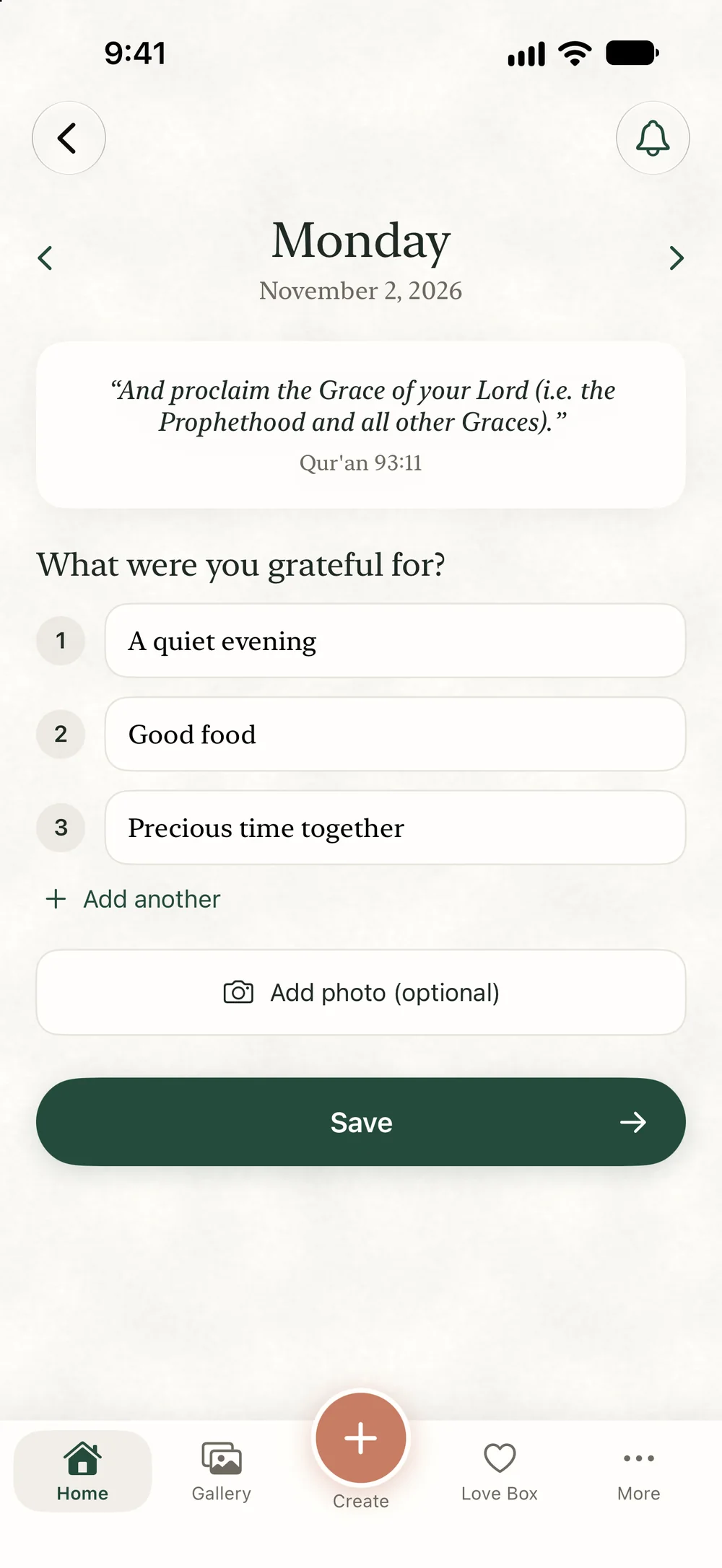
All guides on this topic
- “If You Count the Blessings of Allah”: The Verse and What It Means
“If you should count the favors of Allah, you could not enumerate them”: where the verse is (14:34 and 16:18), what it says and how to notice blessings daily.
- How to Keep the Blessings Allah Gave You
What the Qur’an says about keeping and losing blessings: 14:7, 8:53, the town in 16:112 and Saba’, plus a dua from Sahih Muslim and five daily habits.
- The Health and Free Time Hadith: Two Blessings Many People Lose Out On
The hadith about two blessings many people lose out on, health and free time: its wording, related hadiths and verses, and small ways to use both well.
- “Which of the Favors of Your Lord Will You Deny?” Meaning of Surah ar-Rahman 55:13
Surah ar-Rahman 55:13 in Arabic, transliteration and English: what the verse means, how often it is repeated, who “you both” are and how to answer it.
Name one ni‘mah today
You cannot count them all, and you do not have to. Tonight, write down one blessing you noticed today and say “Alhamdulillah” for it. Tomorrow, find another.
Write it down in Ni’mahFrequently asked questions
- What does ni‘mah mean?
- Ni‘mah (نعمة) is the Arabic word for a blessing, favor or gift. In the Quran it is used for what Allah gives: “And whatever you have of favor - it is from Allāh” (16:53).
- What is the plural of ni‘mah?
- The plural is ni‘am. It appears in Surah Luqman 31:20, where Allah’s favors are described as “apparent and unapparent”.
- Where does the Quran say that blessings cannot be counted?
- In two places: Surah Ibrahim 14:34 and Surah an-Nahl 16:18. Both say that if you should count the favors of Allah, you could not enumerate them.
- Does ni‘mah only mean material things?
- No. In Surah al-Ma’idah 5:3 the word is used for the religion: “This day I have perfected for you your religion and completed My favor upon you.” Surah Luqman 31:20 also speaks of unapparent favors.
- How should a Muslim respond to a ni‘mah?
- With gratitude. Surah Ibrahim 14:7 says: “If you are grateful, I will surely increase you [in favor].” Surah ad-Duha 93:11 adds that the favor of your Lord is to be reported.
- Is Ni’mah free?
- Yes, Ni’mah can be used without a subscription: the gratitude journal, reminders, Love Notes, widgets and 1 illustration per month are included. Ni’mah Pro offers a larger illustration allowance; with the yearly plan, two people can use Ni’mah Together.
Sources
- Surah al-Ma’idah 5:3, Saheeh International (quran.com)
- Surah Ibrahim 14:7, Saheeh International (quran.com)
- Surah Ibrahim 14:34, Saheeh International (quran.com)
- Surah an-Nahl 16:18, Saheeh International (quran.com)
- Surah an-Nahl 16:53, Saheeh International (quran.com)
- Surah Luqman 31:20, Saheeh International (quran.com)
- Surah ad-Duha 93:11, Saheeh International (quran.com)
About the author
Mustafa Ali
Mustafa Ali lives in Medina, the City of the Prophet ﷺ, where he studies Islamic sciences. He built Ni’mah as an Islamic photo app that shows no faces, so families can keep their memories without exposing them to the evil eye and envy.