Ramadan Journal: How to Keep One and What to Write
By Mustafa Ali
In short
A Ramadan journal is one short page a day: your intention, the Qur’an you read, a dua you made, three things you are grateful for and one thing to improve. Five minutes after iftar or Taraweeh are enough. Below are a page layout and 30 daily prompts.
To keep a Ramadan journal, fill in one short page each day of the month: your intention for the day, what you read of the Qur’an, a dua you made, three things you are grateful for and one thing to improve tomorrow. Write at the same time every day, for example after iftar or after Taraweeh. If you do not know what to write, answer one of the 30 prompts below in a sentence or two.
Get Ni’mah on the App Store
What is a Ramadan journal?
A Ramadan journal is a notebook or note in which you write a few lines on each day of the month: what you intended, what you read, what you asked Allah for and what you are grateful for.
It is not a planner full of boxes to tick, and it is not an act of worship in itself. It is a simple help for paying attention, so that the days of the month do not blur into one another, and so that you have something to read when the month is over.
Why Ramadan suits a journal
The verse about the month of fasting names the Qur’an at its beginning and gratitude at its end:
The month of Ramaḍān [is that] in which was revealed the Qur’ān, a guidance for the people and clear proofs of guidance and criterion. So whoever sights [the crescent of] the month, let him fast it; and whoever is ill or on a journey - then an equal number of other days. Allāh intends for you ease and does not intend for you hardship and [wants] for you to complete the period and to glorify Allāh for that [to] which He has guided you; and perhaps you will be grateful.
The very next verse is about dua:
And when My servants ask you, [O Muḥammad], concerning Me - indeed I am near. I respond to the invocation of the supplicant when he calls upon Me. So let them respond to Me [by obedience] and believe in Me that they may be [rightly] guided.
Qur’an, dua and gratitude: these three give a Ramadan journal its shape. Each gets a line on the daily page below.
A hadith about fasting also gives you something to notice each evening:
The Prophet ﷺ said that the fasting person has two joys: one when he breaks his fast, and one when he meets his Lord and is glad because of his fasting.
The first of these two joys comes every day at iftar. It is a good moment to write a line.
How to keep a Ramadan journal
Choose where you write.
A small notebook, the notes on your phone or a journal app. Take the one you will have with you in the evening.
Fix one time.
After iftar, after Taraweeh or before suhoor. The same time every day makes it easier to keep going for the whole month.
Use the same page every day.
Five short lines, as in the table below. You do not have to think about what to do; you only fill it in.
Keep it short and honest.
One sentence per line is enough. Write “two pages of Surah al-Baqarah” or “none today”. The journal is for you, not for anyone else.
Add a prompt when you want more.
On days when you have a few more minutes, answer that day’s prompt from the list of 30 below.
A simple daily page
This layout is our suggestion. Change the lines to fit your days.
| Line | What to write | Example |
|---|---|---|
| Intention | One thing you want from today’s fast. | Today I want to keep my patience with the children before iftar. |
| Qur’an read | What you read or listened to, and one verse that stayed with you. | Surah al-Baqarah 2:183–186. “Indeed I am near.” |
| A dua I made | One thing you asked Allah for today. | For my father’s health. |
| Three things I am grateful for | Specific blessings from today, however small. | Cold water at iftar. My sister’s call. Praying Maghrib together. |
| One thing to improve | One small step for tomorrow. | Put the phone away after Fajr. |
30 Ramadan journal prompts
One short prompt for each day. Answer it in a sentence or two. Ramadan has 29 or 30 days; if the month ends after 29, write the last prompt on Eid.
Days 1–10
- Day 1: What do you hope will be different in you at the end of this month?
- Day 2: Which blessing did you notice at your first iftar?
- Day 3: Which verse that you read or heard today stayed with you?
- Day 4: Who are you fasting alongside, and what are you grateful for in them?
- Day 5: What did hunger or thirst teach you today?
- Day 6: Which dua do you want to repeat every day this month?
- Day 7: What made this first week easier than you expected?
- Day 8: Which habit do you want to leave behind this Ramadan?
- Day 9: Who made a meal, a call or a dua for you this week?
- Day 10: Which prayer today had your full attention?
Days 11–20
- Day 11: What do you want to ask Allah to forgive?
- Day 12: Whom do you need to forgive, or ask for forgiveness?
- Day 13: Which blessing in your home did you notice only because of the fast?
- Day 14: What did you give or share this week?
- Day 15: Halfway: what is going well, and what one thing would you change?
- Day 16: Which name or attribute of Allah did you think about today?
- Day 17: Which Ramadan memory from your childhood are you grateful for?
- Day 18: Who is not at your table this year, and what dua do you make for them?
- Day 19: Which small good deed today did nobody see?
- Day 20: Which verse would you like to learn by heart before the month ends?
Days 21–30
- Day 21: What do you most want to ask Allah for in these nights?
- Day 22: What do you want Allah to pardon?
- Day 23: Which dua do you make for your parents?
- Day 24: Which dua do you make for your children or for the children around you?
- Day 25: Which answered dua from the past can you thank Allah for tonight?
- Day 26: What did you understand in the Qur’an this month that you had missed before?
- Day 27: What would you say to Allah tonight in your own words?
- Day 28: Which habit from this month do you want to keep afterwards?
- Day 29: Which three blessings of this Ramadan do you never want to forget?
- Day 30: What do you thank Allah for as the month is completed?
Laylat al-Qadr: a dua to write down
Ramadan contains Laylat al-Qadr, the Night of Decree. A hadith in Sahih al-Bukhari speaks about standing in prayer on that night:
The Prophet ﷺ said that whoever fasts Ramadan with faith and hoping for reward from Allah will have his past sins forgiven, and whoever stands in prayer on the Night of Qadr with faith and hoping for reward will have his past sins forgiven.
‘A’ishah, may Allah be pleased with her, asked the Prophet ﷺ what she should say if she knew which night it was. He taught her this dua. Write it on a page of its own so you have it ready:
اللَّهُمَّ إِنَّكَ عَفُوٌّ كَرِيمٌ تُحِبُّ الْعَفْوَ فَاعْفُ عَنِّي
Allahumma innaka ‘afuwwun karimun tuhibbul-‘afwa fa‘fu ‘anni.
O Allah, indeed You are Pardoning, Generous; You love pardon, so pardon me.
In your journal you can add underneath what you are asking pardon for, and the duas you want to make for yourself and your family.
Paper journal or app?
Both work for Ramadan. A notebook next to your prayer mat keeps the screen away. An app is practical if your phone is what you have with you after iftar or Taraweeh, and it can remind you on the evenings you would otherwise forget.
Ni’mah is a Muslim gratitude journal for iPhone that we built for Muslim families. You write down what you are grateful for each day, and a reminder helps you keep the habit. Your memories are stored on your iPhone and, with iCloud sync, in your private iCloud. If you like, a photo becomes an illustration in which faces are not recognizable.
Without a subscription, the gratitude journal, reminders, Love Notes, widgets and 1 illustration per month are included. Ni’mah Pro gives you a larger illustration allowance.
Ni’mah is our own app.
Download Ni’mah on the App Store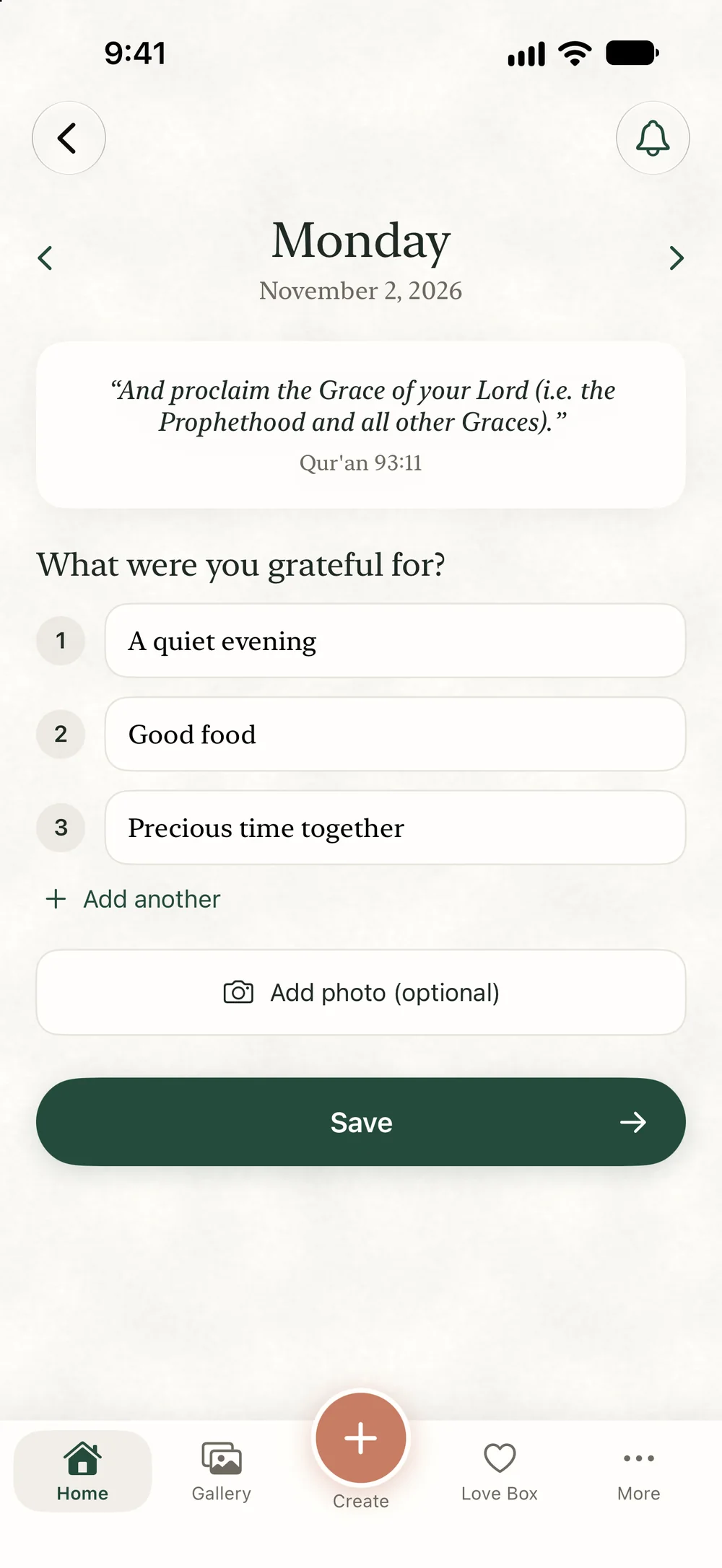
Start on the first evening
You do not need a special notebook. On the first evening of Ramadan, write five short lines: your intention, what you read, one dua, three blessings and one thing for tomorrow. Do it again the next day.
Start your Ramadan journal in Ni’mahFrequently asked questions
- What do you write in a Ramadan journal?
- A few short lines each day: your intention for the fast, what you read of the Qur’an, a dua you made, three things you are grateful for and one thing to improve tomorrow. A daily prompt can add one more sentence.
- When is the best time to write?
- Choose one fixed time that fits your day, for example after iftar, after Taraweeh or before suhoor. The same time every day makes the habit easier to keep for the whole month.
- What if I miss a day?
- Leave the page empty and continue with today. A Ramadan journal is a help for paying attention, not a duty, and there is nothing to catch up on.
- What is the dua for Laylat al-Qadr?
- The Prophet ﷺ taught ‘A’ishah to say: “Allahumma innaka ‘afuwwun karimun tuhibbul-‘afwa fa‘fu ‘anni”, “O Allah, indeed You are Pardoning, Generous; You love pardon, so pardon me” (Jami‘ at-Tirmidhi, no. 3513, graded sahih by Darussalam).
- Can children keep a Ramadan journal?
- Yes. For children, keep it to one or two lines a day, for example one thing they are grateful for and one good deed they did. Younger children can tell you their answer and you write it down.
- Is Ni’mah free?
- Yes, Ni’mah can be used without a subscription: the gratitude journal, reminders, Love Notes, widgets and 1 illustration per month are included. Ni’mah Pro offers a larger illustration allowance; with the yearly plan, two people can use Ni’mah Together.
Sources
- Surah al-Baqarah 2:185, Saheeh International (quran.com)
- Surah al-Baqarah 2:186, Saheeh International (quran.com)
- Sahih al-Bukhari, no. 1904 (sunnah.com)
- Sahih al-Bukhari, no. 2014 (sunnah.com)
- Jami‘ at-Tirmidhi, no. 3513 (sunnah.com)
Read also
Related guides
- Free Printable Gratitude Journal for Muslims: 30 Days of Shukr (PDF)
Download a free 30-day shukr journal for Muslims as a printable PDF: a prompt for every day, space for three blessings, and duas for gratitude with sources.
- Muhasaba: Meaning and a Gentle Evening Routine
What muhasaba means, the Qur’an verses behind it and a gentle five-minute evening routine with example questions for taking yourself to account.
- 40 Muslim Journal Prompts for Every Kind of Day
40 simple Muslim journal prompts in five groups: gratitude, family, worship and Qur’an, hardship and patience, hopes and duas. With verses and a closing dua.
- Teaching Children Gratitude in Islam
How to teach a child to be grateful to Allah: Luqman’s advice, three small Sunnah habits, ideas by age and a two-minute bedtime routine. With sources.
- Umrah Journal: What to Write Before, During and After the Journey
How to keep an Umrah or Hajj journal: what to write before, during and after the journey, prompts for Makkah and Madinah, and a dua list. With sources.
About the author
Mustafa Ali
Mustafa Ali lives in Medina, the City of the Prophet ﷺ, where he studies Islamic sciences. He built Ni’mah as an Islamic photo app that shows no faces, so families can keep their memories without exposing them to the evil eye and envy.