Sharing Photos of Your Children and the Evil Eye: What Muslims Should Know
By Mustafa Ali
In short
Posting photos of your children is not forbidden in general, but many scholars advise restraint because the evil eye is real. Say Mā shā’ Allāh when you admire something, recite the Prophet’s ﷺ dua for your children, and share less publicly. You can also keep and share moments without showing anyone’s face.
Islam does not forbid sharing photos of your children in general. The Prophet ﷺ said that the evil eye is real (Muslim 2188), and fatwa bodies such as the Federal Territories Mufti Office in Malaysia therefore advise caution rather than a ban: pray for blessing when you admire something, protect your children with the Prophet’s ﷺ dua, and avoid showing off. Scholars also warn against living in constant fear of the evil eye.
Get Ni’mah on the App Store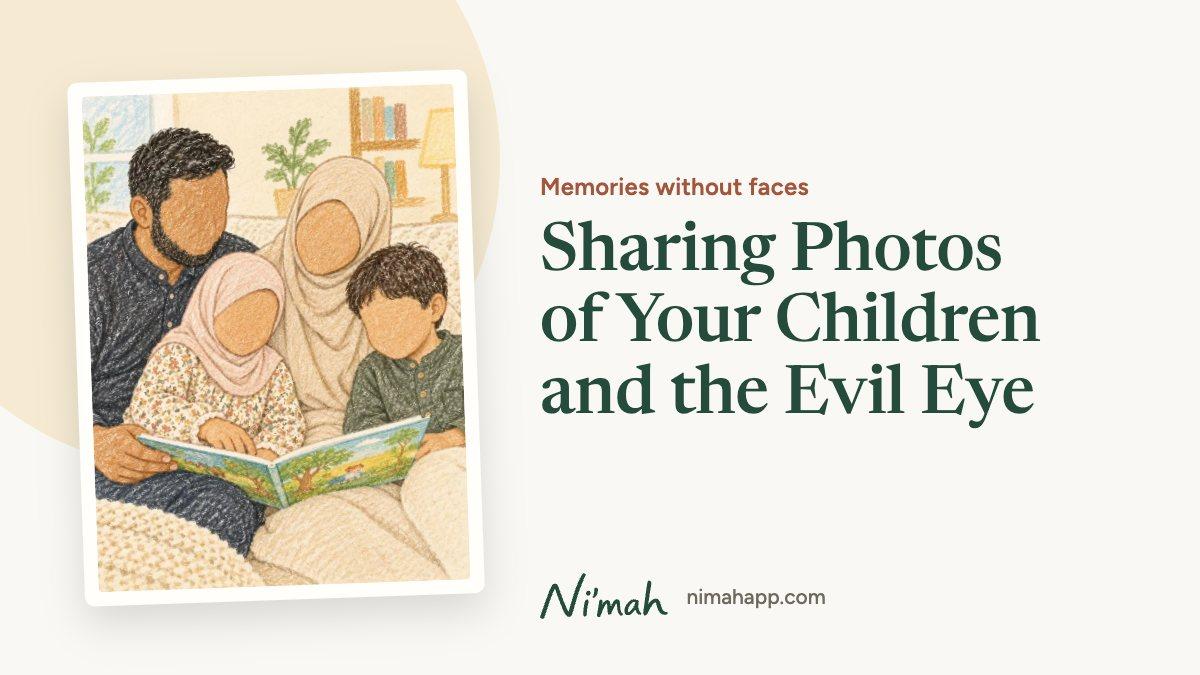
Is it allowed to post photos of my children?
This is one of the most common questions Muslim parents ask today. The answers of fatwa bodies point in the same direction: there is no specific prohibition on sharing a photo of your child, but there are good reasons to be careful.
The Federal Territories Mufti Office in Malaysia (Al-Kafi #458) writes that the evil eye can happen through a photo as well as face to face, and gives three precautions: whoever admires something should pray for blessing, parents should recite the Prophet’s ﷺ dua for their children, and they should avoid amulets and superstitious practices. Islamweb (fatwa 501409) adds that hiding a blessing when you fear envy is a legitimate means and does not contradict trust in Allah, especially when showing it brings no benefit.
What the sources say about the evil eye
The Prophet ﷺ said that the evil eye is real.
When Yusuf عليه السلام told his father about his dream, Yaʿqub عليه السلام advised him not to tell his brothers:
He said, “O my son, do not relate your vision to your brothers or they will contrive against you a plan. Indeed Satan, to man, is a manifest enemy.
Scholars cite this verse as a basis for keeping a blessing to yourself when you fear that someone will envy it.
At the same time, the Qur’an tells us to speak of Allah’s favour:
But as for the favor of your Lord, report [it].
So there is a balance: speaking of a blessing out of gratitude is good, displaying it to impress people is not. Islamweb warns against the other extreme too: the fear of the evil eye should not become a chain around a Muslim’s neck that fills life with worry.
What to say when you see a photo of a child
When you see something you like in someone else, the Prophet ﷺ taught that you should pray for blessing for them. Many Muslims say Bārakallāhu fīk (may Allah bless you) or Mā shā’ Allāh.
When ʿAmir ibn Rabiʿah admired how Sahl ibn Hunayf looked and Sahl fell ill, the Prophet ﷺ asked why one of them would harm his brother, and said that if someone sees something he likes in his brother, he should pray for blessing for him.
The words Mā shā’ Allāh come from Surah al-Kahf, where a man is reminded what he should have said when he looked at his own garden:
مَا شَآءَ ٱللَّهُ لَا قُوَّةَ إِلَّا بِٱللَّهِ
Mā shā’ Allāh, lā quwwata illā billāh.
What Allah wills [happens]; there is no power except with Allah.
Saying this when you admire your own child, or someone else’s, ties the blessing back to Allah.
How to protect your children
The Prophet ﷺ sought refuge with Allah for his grandsons al-Hasan and al-Husayn with these words:
أَعُوذُ بِكَلِمَاتِ اللَّهِ التَّامَّةِ مِنْ كُلِّ شَيْطَانٍ وَهَامَّةٍ، وَمِنْ كُلِّ عَيْنٍ لاَمَّةٍ
Aʿūdhu bi-kalimāti llāhi t-tāmmati min kulli shayṭānin wa hāmmah, wa min kulli ʿaynin lāmmah.
I seek refuge in the perfect words of Allah from every devil and every harmful creature, and from every evil eye.
Every night before sleep, the Prophet ﷺ recited Surah al-Ikhlas, al-Falaq and an-Nas, blew into his hands and wiped them over his body, three times.
Parents can recite this over their children before sleep. Protection comes from Allah; amulets, blue beads and similar objects are not part of it.
A checklist before you post
Ask why.
Do you want to share joy with people you love, or collect likes? The intention decides a lot.
Choose who sees it.
A photo in a family chat reaches a few people; a public post reaches strangers.
Leave out details.
No location, school, daily routine or full name.
Remember your child’s future.
Would your child be happy to find this picture online in ten years?
Say Mā shā’ Allāh and recite.
Tie the moment back to Allah before you share it.
Keeping memories without showing faces
Many parents find a middle way: they keep the photo, but share it privately, cover the face, or share an image in which no one can be recognised. In some countries parents cover their children’s faces with an emoji for this reason.
Whether drawings of people without facial features are permissible is a question scholars answer differently. This page gives no ruling on it; ask a qualified person if you need an answer.
Your children’s moments, without their faces
Ni’mah is a gratitude journal for Muslims on iPhone that we built. A photo of your child can become a warm illustration in which no one has a recognisable face, so you can keep the moment and share it with family without showing who is in it.
With each illustration you can note what you were grateful for, and Ni’mah asks you every day: “What are you grateful for today?” Your entries stay on your device. The app does not promise protection from the evil eye; it simply shows no faces.
Without a subscription you get the gratitude journal, reminders, Love Notes and 1 illustration per month. Ni’mah Pro gives you a larger illustration allowance.
Ni’mah is our own app.
Get Ni’mah on the App Store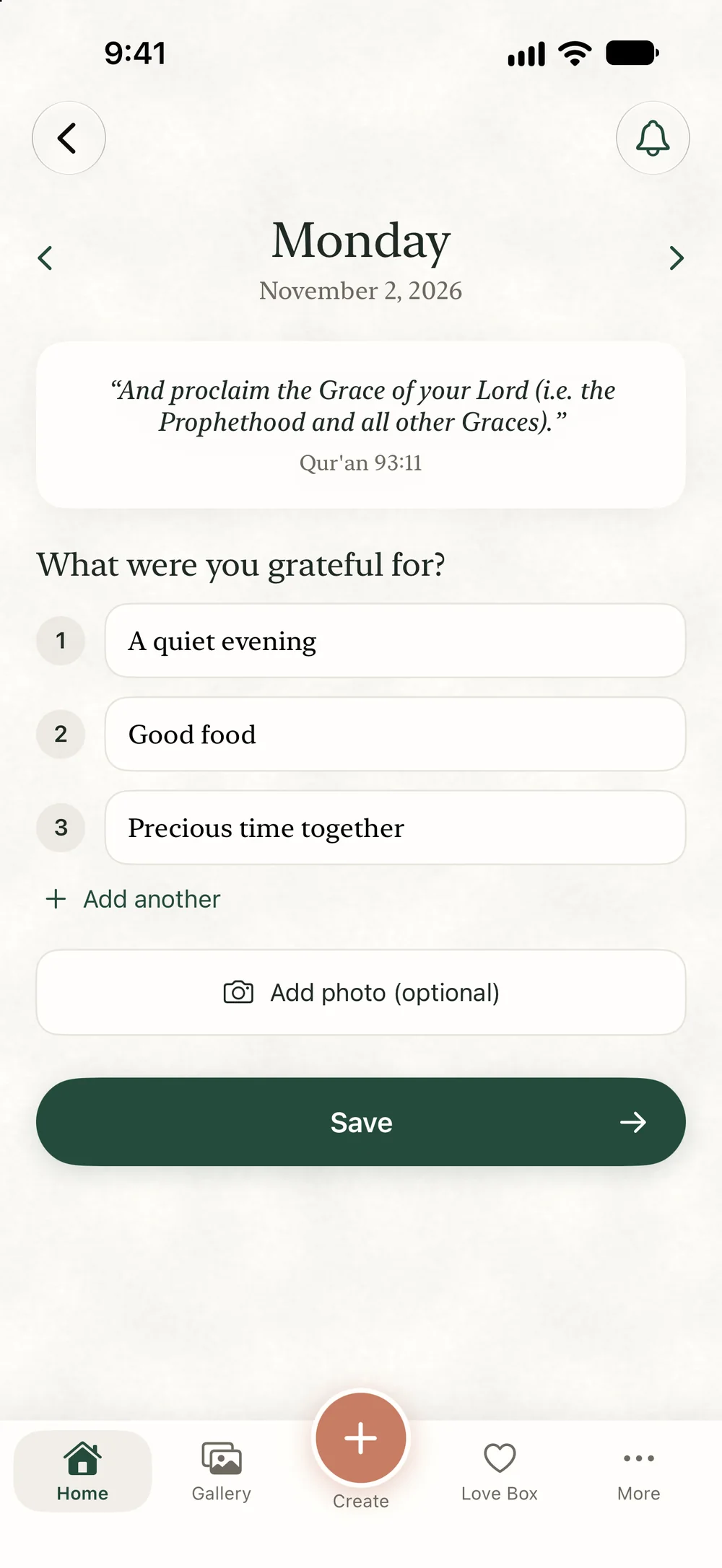
Overview
| Situation | What you can do | Source |
|---|---|---|
| You admire a child or a photo | Pray for blessing: Bārakallāhu fīk, Mā shā’ Allāh | Ibn Majah 3509; Qur’an 18:39 |
| Every night | Recite al-Ikhlas, al-Falaq and an-Nas | Bukhari 5017 |
| For your children | Aʿūdhu bi-kalimāti llāhi t-tāmmah … | Bukhari 3371 |
| You fear envy | Keep the blessing to yourself, without living in fear | Qur’an 12:5; Islamweb 501409 |
Before your next photo
Say Mā shā’ Allāh, recite the Prophet’s ﷺ dua over your children tonight, and keep one moment in your journal without showing a face.
Keep your moments in Ni’mahFrequently asked questions
- Is it haram to post pictures of my children?
- Fatwa bodies do not forbid it in general. They advise caution because the evil eye is real (Muslim 2188): avoid showing off, share less publicly, and protect your children with the Prophet’s ﷺ dua.
- Can the evil eye affect someone through a photo?
- The Federal Territories Mufti Office in Malaysia writes, citing Ibn al-Qayyim, that the evil eye can occur without seeing a person directly, for example through pictures.
- What should I say when I see a cute baby photo?
- Pray for blessing for the child, for example Bārakallāhu fīh or Mā shā’ Allāh. The Prophet ﷺ taught this when someone admires something in another person (Ibn Majah 3509).
- Which dua protects children from the evil eye?
- The Prophet ﷺ said for al-Hasan and al-Husayn: “Aʿūdhu bi-kalimāti llāhi t-tāmmati min kulli shayṭānin wa hāmmah, wa min kulli ʿaynin lāmmah” (Bukhari 3371).
- Does covering my child’s face protect from the evil eye?
- Protection comes from Allah. Not showing a face is a precaution many parents choose, like not sharing at all; it is not a guarantee.
Sources
- Surah Yusuf 12:5 (Saheeh International)
- Surah ad-Duha 93:11 (Saheeh International)
- Surah al-Kahf 18:39 (Saheeh International)
- Muslim, no. 2188
- Ibn Majah, no. 3509
- Bukhari, no. 3371
- Bukhari, no. 5017
- Federal Territories Mufti Office (Malaysia), Al-Kafi #458: uploading pictures of a newborn on Facebook
- Islamweb, fatwa 501409 (Arabic)
Read also
Related guides
- Islamic Photo App Without Faces: Family Memories as Illustrations
An Islamic photo app that shows no faces: Ni’mah turns family photos into illustrations without recognizable faces. Here is how it works.
- Duas for Protection in Islam: Morning, Evening and Before Sleep
Duas for protection from the Quran and Sunnah in Arabic with transliteration and meaning: Ayat al-Kursi, the three Quls and the Prophet’s ﷺ daily adhkar.
- Evil Eye (Ayn) and Hasad: What Is the Difference?
Evil eye (ayn) and hasad (envy) are related but not the same. What each means in Islam, what the Quran and hadith say, and how to seek protection.
About the author
Mustafa Ali
Mustafa Ali lives in Medina, the City of the Prophet ﷺ, where he studies Islamic sciences. He built Ni’mah as an Islamic photo app that shows no faces, so families can keep their memories without exposing them to the evil eye and envy.