“Which of the Favors of Your Lord Will You Deny?” Meaning of Surah ar-Rahman 55:13
By Mustafa Ali
In short
The verse is Surah ar-Rahman 55:13: “So which of the favors of your Lord would you deny?” It is a question to which the honest answer is “none”. It is repeated 31 times in the surah, each time after blessings or signs of Allah have been named.
“Which of the favors of your Lord will you deny?” is verse 13 of Surah ar-Rahman, the 55th surah of the Qur’an. In Arabic it reads “Fa-bi-ayyi ala’i rabbikuma tukadhdhiban”. The surah lists what Allah has given, then asks this question again and again, 31 times in 78 verses. The Arabic addresses two, and the surah itself names mankind and the jinn.
Get Ni’mah on the App Store
The verse in Arabic and English
The verse appears for the first time in Surah ar-Rahman 55:13. This is the Saheeh International translation:
So which of the favors of your Lord would you deny?
| Surah ar-Rahman 55:13 | |
|---|---|
| Arabic | فَبِأَىِّ ءَالَآءِ رَبِّكُمَا تُكَذِّبَانِ |
| Transliteration | Fa-bi-ayyi ala’i rabbikuma tukadhdhiban |
| English (Saheeh International) | So which of the favors of your Lord would you deny? |
You will often see the verse worded as “Which of the favors of your Lord will you deny?” The translation quoted here says “would you deny”. Both wordings render the same Arabic sentence.
Three words carry the verse. “Ala’” is translated as “favors”. “Rabbikuma” means “the Lord of you two”: the ending “-kuma” is the Arabic dual, used when exactly two are addressed. “Tukadhdhiban” is also in the dual and is translated as “would you deny”.
How often is the verse repeated in Surah ar-Rahman?
The verse occurs 31 times. We counted it in the Arabic text of the surah for this article: 31 of the 78 verses have exactly the same wording as verse 13.
The first occurrence is verse 13 and the last is verse 77, one verse before the end. So from verse 13 on, the question returns after every one or two verses. It works like a refrain: something is named, and then you are asked whether you can deny it.
Who is “you both”?
English “you” hides it, but the Arabic speaks to two. The surah does not leave you guessing who they are. Directly after the first refrain it names two creations:
He created man from clay like [that of] pottery. And He created the jinn from a smokeless flame of fire.
Later, the surah addresses both of them together by name:
O company of jinn and mankind
So within the surah itself, the two that are created and spoken to are mankind and the jinn. That includes you: every time the question is recited, it is also put to you.
Which favors come before the question?
The surah does not open with the question. It opens with the name ar-Rahman, the Most Merciful, and with what He has given:
The Most Merciful Taught the Qur’ān, Created man, [And] taught him eloquence.
Just before the refrain is heard for the first time, the surah turns to the earth and its food:
And the earth He laid [out] for the creatures. Therein is fruit and palm trees having sheaths [of dates] And grain having husks and scented plants.
Among the favors named before verse 13 are these:
| Favor | Verse |
|---|---|
| He taught the Qur’an | 55:2 |
| He created man | 55:3 |
| He taught man eloquence, the ability to express himself | 55:4 |
| He laid out the earth for the creatures | 55:10 |
| Fruit, date palms, grain and scented plants | 55:11–12 |
Notice the order. Guidance comes first, then your own existence, then speech, then the ground under your feet and the food on your table. None of these are things you made for yourself. Only then comes the question.
The reply reported from the jinn
A hadith in Jami‘ at-Tirmidhi reports how the question was once answered. Its grading on sunnah.com is hasan (Darussalam).
Jabir said that the Messenger of Allah ﷺ recited Surah ar-Rahman to his Companions from beginning to end, and they stayed silent. He told them that he had recited it to the jinn and that they had responded better: each time he reached this verse, they said, “We do not deny any of Your favors, our Lord, and all praise is Yours.”
These are the words of the reply as the hadith gives them:
لاَ بِشَيْءٍ مِنْ نِعَمِكَ رَبَّنَا نُكَذِّبُ فَلَكَ الْحَمْدُ
La bi-shay’in min ni‘amika rabbana nukadhdhibu, fa-laka al-hamd.
We do not deny any of Your favors, our Lord, and all praise is Yours.
The reply shows what the question is for. It is not asked so that you stay silent. It is asked so that you acknowledge the favor and praise the One who gave it.
How to answer the verse with gratitude
These are our own practical suggestions, not rulings. They are simple ways to let the question reach you in daily life.
Read or listen to the surah slowly.
Pause briefly each time the question comes. Look at what was named just before it.
Answer in your heart.
The honest answer is “none of them”. You can use the words of the reply above, or simply say “Alhamdulillah”.
Name one favor of your own.
The surah is specific: speech, the earth, fruit, grain. Be just as specific. Not “my life”, but “I could speak with my mother today”.
Write it down.
One line in a notebook or a journal is enough. A written blessing is harder to forget, and you can read it again on a hard day.
Use the favor well.
Gratitude also shows in what you do with a blessing: a kind word with the speech you were given, a shared meal from the food you were given.
A place to write your answer
If you want to answer the verse with one written blessing a day, paper works well. An app is practical if your phone is always with you.
Ni’mah is a Muslim gratitude journal for iPhone that we built for Muslim families. You write down what you are grateful for each day, and a reminder helps you keep the habit. Your memories are stored on your iPhone and, with iCloud sync, in your private iCloud. If you like, a photo becomes an illustration in which faces are not recognizable.
Without a subscription, the gratitude journal, reminders, Love Notes, widgets and 1 illustration per month are included. Ni’mah Pro gives you a larger illustration allowance.
Ni’mah is our own app.
Download Ni’mah on the App Store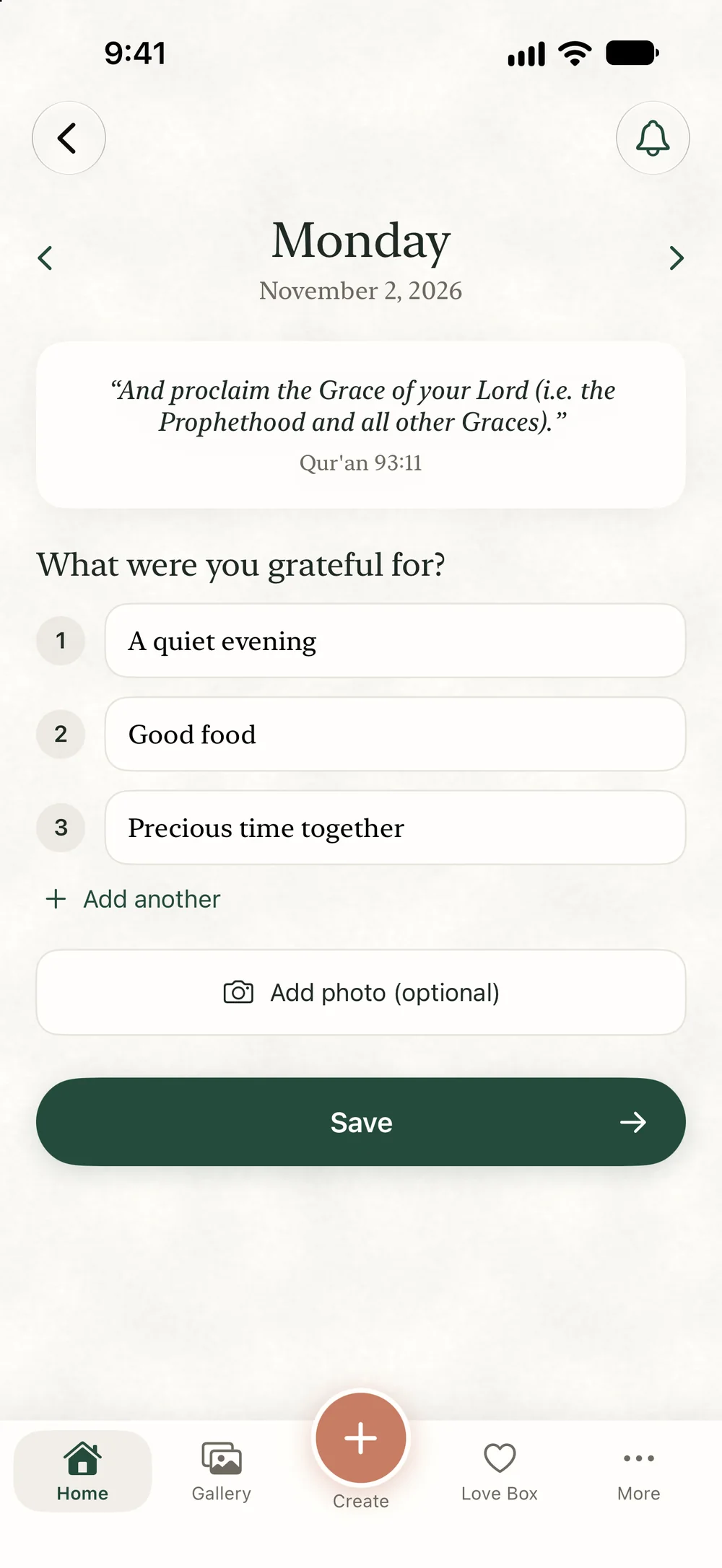
Answer the question today
The verse asks which favor you would deny. Tonight, name one that you would not: write it down in a single line and say “Alhamdulillah”. Do it again tomorrow.
Write today’s blessing in Ni’mahFrequently asked questions
- What does “Fa-bi-ayyi ala’i rabbikuma tukadhdhiban” mean?
- It is Surah ar-Rahman 55:13. Saheeh International translates it as “So which of the favors of your Lord would you deny?” It is often also worded as “Which of the favors of your Lord will you deny?”
- How many times is the verse repeated in Surah ar-Rahman?
- 31 times. We counted the verses of the surah whose Arabic text is identical to verse 13: there are 31 among the 78 verses, the first being verse 13 and the last verse 77.
- Who is addressed by “you both”?
- The Arabic uses the dual, so two are addressed. The surah itself names them: it mentions the creation of man and of the jinn in 55:14–15 and addresses the “company of jinn and mankind” in 55:33.
- Which surah contains the verse?
- Surah ar-Rahman, the 55th surah of the Qur’an. It has 78 verses and is named after its first verse, “ar-Rahman”, the Most Merciful.
- Is there a reply to the verse in the Sunnah?
- A hadith in Jami‘ at-Tirmidhi, no. 3291, graded hasan (Darussalam) on sunnah.com, reports that the jinn replied each time: “We do not deny any of Your favors, our Lord, and all praise is Yours.” For questions about when to say it, please ask a scholar you trust.
- How can I act on the verse every day?
- Name one specific favor a day, say “Alhamdulillah” for it and write it down. This is our practical suggestion, not a prescribed form.
Sources
- Surah ar-Rahman 55:1–4, Saheeh International (quran.com)
- Surah ar-Rahman 55:10–12, Saheeh International (quran.com)
- Surah ar-Rahman 55:13, Saheeh International (quran.com)
- Surah ar-Rahman 55:14–15, Saheeh International (quran.com)
- Surah ar-Rahman 55:33, Saheeh International (quran.com)
- Surah ar-Rahman, full Arabic text used for the count (quran.com)
- Jami‘ at-Tirmidhi, no. 3291 (sunnah.com)
Related guides
- “If You Count the Blessings of Allah”: The Verse and What It Means
“If you should count the favors of Allah, you could not enumerate them”: where the verse is (14:34 and 16:18), what it says and how to notice blessings daily.
- How to Keep the Blessings Allah Gave You
What the Qur’an says about keeping and losing blessings: 14:7, 8:53, the town in 16:112 and Saba’, plus a dua from Sahih Muslim and five daily habits.
- Ni’mah Meaning: What Does Ni‘mah (نعمة) Mean in Islam?
Ni‘mah (نعمة) means blessing, favor or gift. What the Quran says about the blessings of Allah: where they come from, their kinds and how to respond.
- The Health and Free Time Hadith: Two Blessings Many People Lose Out On
The hadith about two blessings many people lose out on, health and free time: its wording, related hadiths and verses, and small ways to use both well.
About the author
Mustafa Ali
Mustafa Ali lives in Medina, the City of the Prophet ﷺ, where he studies Islamic sciences. He built Ni’mah as an Islamic photo app that shows no faces, so families can keep their memories without exposing them to the evil eye and envy.