The Health and Free Time Hadith: Two Blessings Many People Lose Out On
By Mustafa Ali
In short
The Prophet ﷺ said that there are two blessings many people lose out on: health and free time (Sahih al-Bukhari, no. 6412). Both are easy to overlook while you have them. Below you will find the hadith, related sources and small ways to use both.
The hadith about two blessings is in Sahih al-Bukhari, no. 6412, narrated by Ibn ‘Abbas. The Prophet ﷺ said that there are two blessings that many people are deceived into losing: health and free time. Another hadith names safety, health and food for the day, and the Qur’an says that you will be asked about the blessings you enjoyed.
Get Ni’mah on the App Store
The hadith: two blessings many people lose out on
The hadith is short. Ibn ‘Abbas, may Allah be pleased with him and his father, narrates it from the Prophet ﷺ.
The Prophet ﷺ said that there are two blessings that many people are deceived into losing: health and free time.
| Sahih al-Bukhari, no. 6412 | |
|---|---|
| Arabic | نِعْمَتَانِ مَغْبُونٌ فِيهِمَا كَثِيرٌ مِنَ النَّاسِ، الصِّحَّةُ وَالْفَرَاغُ |
| Transliteration | Ni‘matani maghbunun fihima kathirun mina n-nas: as-sihhatu wal-faragh. |
| The two blessings | Health (as-sihhah) and free time (al-faragh) |
The Arabic word for “blessing” here is ni‘mah, the same word the Qur’an uses for the favors of Allah. The hadith uses its dual form, ni‘matan: two blessings.
What the hadith points to
The hadith does not say that health and free time are rare. It says that many people lose out on them. The translation on sunnah.com words it as being “deceived into losing” them.
Here is how we read it for daily life; this is our reflection, not a commentary. Both blessings are quiet. A healthy body does not announce itself, and a free hour passes without a sound. You usually notice them when they are gone: on the first day of an illness, or in a week when you have no time at all. The hadith invites you to notice them earlier.
Safety, health and food for the day
A second hadith names three everyday blessings and tells you how much they are worth. It is in Jami‘ at-Tirmidhi and is graded hasan (Darussalam) on sunnah.com.
The Messenger of Allah ﷺ said that whoever among you wakes up in the morning safe in his home, healthy in his body and with his food for the day, it is as if the whole world has been gathered for him.
Health appears in both hadiths. This one adds safety where you live and enough to eat today. If you woke up with these three this morning, the hadith says you are not missing the world.
Look at those below you
Blessings are often overlooked because of comparison. You look at someone who has more, and what you have seems small. A hadith in Sahih Muslim turns the gaze around.
The Messenger of Allah ﷺ said that when one of you looks at someone who has been given more than him in wealth and in physical form, he should look at someone who is below him in these things.
You will be asked about your blessings
The Qur’an states plainly where every blessing comes from:
And whatever you have of favor - it is from Allāh. Then when adversity touches you, to Him you cry for help.
And Surah at-Takathur ends with a reminder that the good you enjoyed will not go unmentioned:
Then you will surely be asked that Day about pleasure.
Read together, the sources draw one picture. Health, time, safety and food are favors from Allah. Many people lose out on them. And you will be asked about them. Noticing them and using them well is a way to prepare for that question.
Four overlooked blessings and one small way to use each
The first column comes from the two hadiths above. The other two columns are our own practical suggestions. They are not taken from the sources.
| Blessing | How it is easily wasted | One small way to use it |
|---|---|---|
| Health (Bukhari, no. 6412; Tirmidhi, no. 2346) | You only think about it when something hurts. | Do one thing today that needs a healthy body: pray without hurry, walk to the mosque, carry the shopping for someone. |
| Free time (Bukhari, no. 6412) | Free minutes disappear into the phone without a decision. | Give the next free ten minutes a purpose before they start: a page of Qur’an, a call to your parents, a short walk. |
| Safety at home (Tirmidhi, no. 2346) | A quiet night feels like nothing happened. | Say “Alhamdulillah” when you lock the door at night, and make dua for people who have no safe place. |
| Food for the day (Tirmidhi, no. 2346) | Meals are eaten on the side, and leftovers are thrown away. | Eat one meal today without a screen, and share or save what is left. |
A two-minute habit
If you want to keep these blessings in view, a short daily note helps. This too is a practical suggestion.
Ask the morning question.
Am I safe, am I healthy, do I have food for today? If yes, say “Alhamdulillah” before you pick up your phone.
Plan one use.
Decide on one thing you will do with your health or with a free moment today.
Write one line at night.
Note which blessing you noticed and what you did with it. One sentence is enough.
Keep your blessings in view
A notebook is enough for the one line at night. An app is practical if your phone is always with you and you want a reminder.
Ni’mah is a Muslim gratitude journal for iPhone that we built for Muslim families. You write down what you are grateful for each day, and a reminder helps you keep the habit. Your memories are stored on your iPhone and, with iCloud sync, in your private iCloud. If you like, a photo becomes an illustration in which faces are not recognizable.
Without a subscription, the gratitude journal, reminders, Love Notes, widgets and 1 illustration per month are included. Ni’mah Pro gives you a larger illustration allowance.
Ni’mah is our own app.
Download Ni’mah on the App Store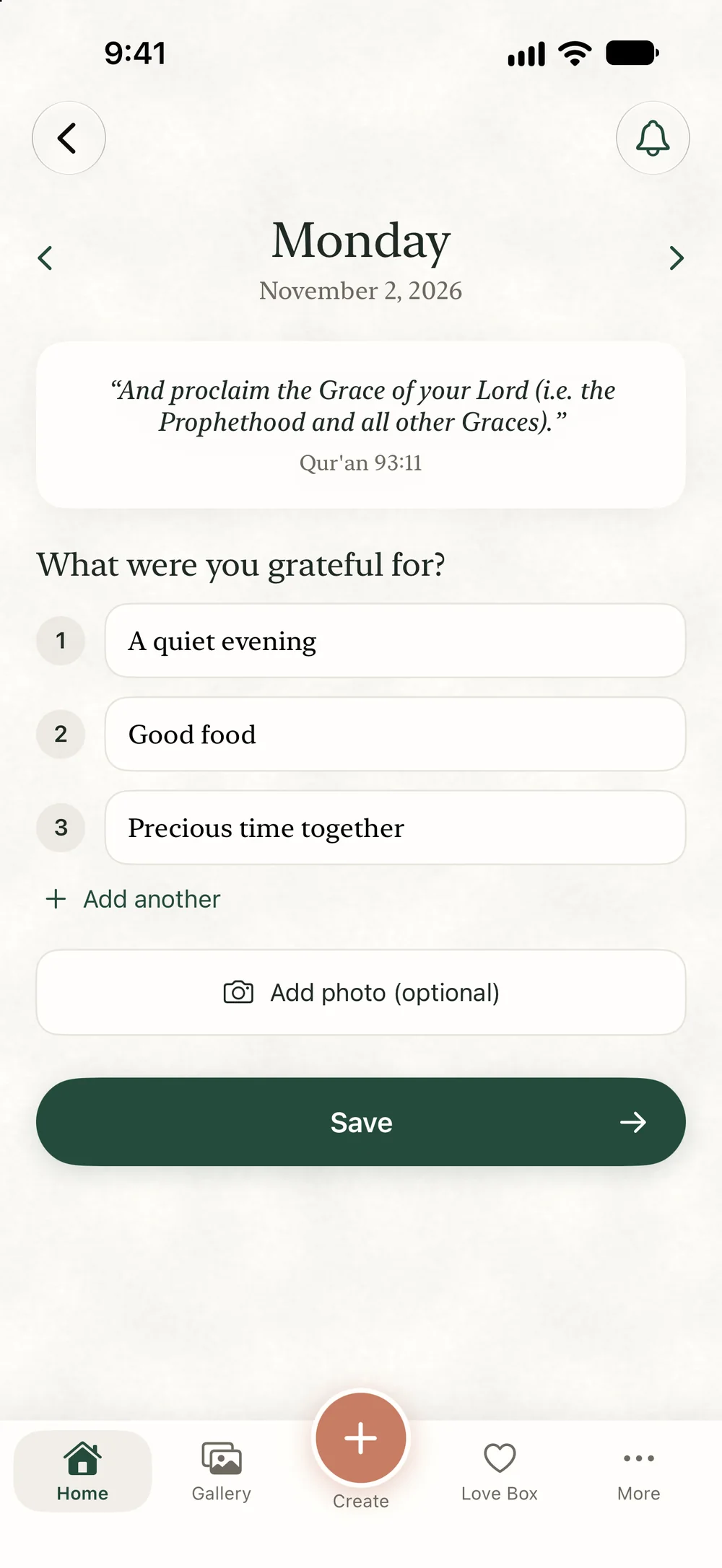
Notice them while you have them
If you are healthy today and have a free moment, you hold both blessings from the hadith right now. Tonight, write down one line about how you used them, and say “Alhamdulillah”.
Write today’s blessing in Ni’mahFrequently asked questions
- What is the hadith about health and free time?
- It is in Sahih al-Bukhari, no. 6412, narrated by Ibn ‘Abbas: the Prophet ﷺ said that there are two blessings that many people are deceived into losing, health and free time.
- What are the two blessings many people lose out on?
- Health and free time. In the Arabic of the hadith they are “as-sihhah” and “al-faragh”.
- Which hadith mentions safety, health and food for the day?
- Jami‘ at-Tirmidhi, no. 2346, graded hasan (Darussalam) on sunnah.com. It says that whoever wakes up safe in his home, healthy in his body and with his food for the day, it is as if the world has been gathered for him.
- Will we be asked about our blessings?
- Surah at-Takathur 102:8 says: “Then you will surely be asked that Day about pleasure.” And Surah an-Nahl 16:53 says that whatever favor you have is from Allah.
- What helps when I keep comparing myself with others?
- A hadith in Sahih Muslim, no. 2963a, advises that when you look at someone who has been given more in wealth and physical form, you should look at someone who is below you in these things.
- How can I be grateful for health and free time in practice?
- Our suggestion: notice them in the morning, plan one good use for each during the day and write one line about it at night. A gratitude journal makes this easy to keep up.
Sources
- Sahih al-Bukhari, no. 6412 (sunnah.com)
- Jami‘ at-Tirmidhi, no. 2346 (sunnah.com)
- Sahih Muslim, no. 2963a (sunnah.com)
- Surah an-Nahl 16:53, Saheeh International (quran.com)
- Surah at-Takathur 102:8, Saheeh International (quran.com)
Read also
Related guides
- “If You Count the Blessings of Allah”: The Verse and What It Means
“If you should count the favors of Allah, you could not enumerate them”: where the verse is (14:34 and 16:18), what it says and how to notice blessings daily.
- How to Keep the Blessings Allah Gave You
What the Qur’an says about keeping and losing blessings: 14:7, 8:53, the town in 16:112 and Saba’, plus a dua from Sahih Muslim and five daily habits.
- Ni’mah Meaning: What Does Ni‘mah (نعمة) Mean in Islam?
Ni‘mah (نعمة) means blessing, favor or gift. What the Quran says about the blessings of Allah: where they come from, their kinds and how to respond.
- “Which of the Favors of Your Lord Will You Deny?” Meaning of Surah ar-Rahman 55:13
Surah ar-Rahman 55:13 in Arabic, transliteration and English: what the verse means, how often it is repeated, who “you both” are and how to answer it.
About the author
Mustafa Ali
Mustafa Ali lives in Medina, the City of the Prophet ﷺ, where he studies Islamic sciences. He built Ni’mah as an Islamic photo app that shows no faces, so families can keep their memories without exposing them to the evil eye and envy.