Teaching Children Gratitude in Islam
By Mustafa Ali
In short
Start small and do it together. Say “Bismillah” before eating and “Alhamdulillah” after, thank people out loud, and each night name three things you thank Allah for. Children learn gratitude mostly by hearing and seeing it from you.
You teach a child to be grateful to Allah by making gratitude part of ordinary moments. Begin meals with Allah’s name and end them with “Alhamdulillah”, thank the people who do something for you, and name blessings together before sleep. The Quran shows the same order in Luqman’s advice: gratitude to Allah first, then to parents.
Get Ni’mah on the App Store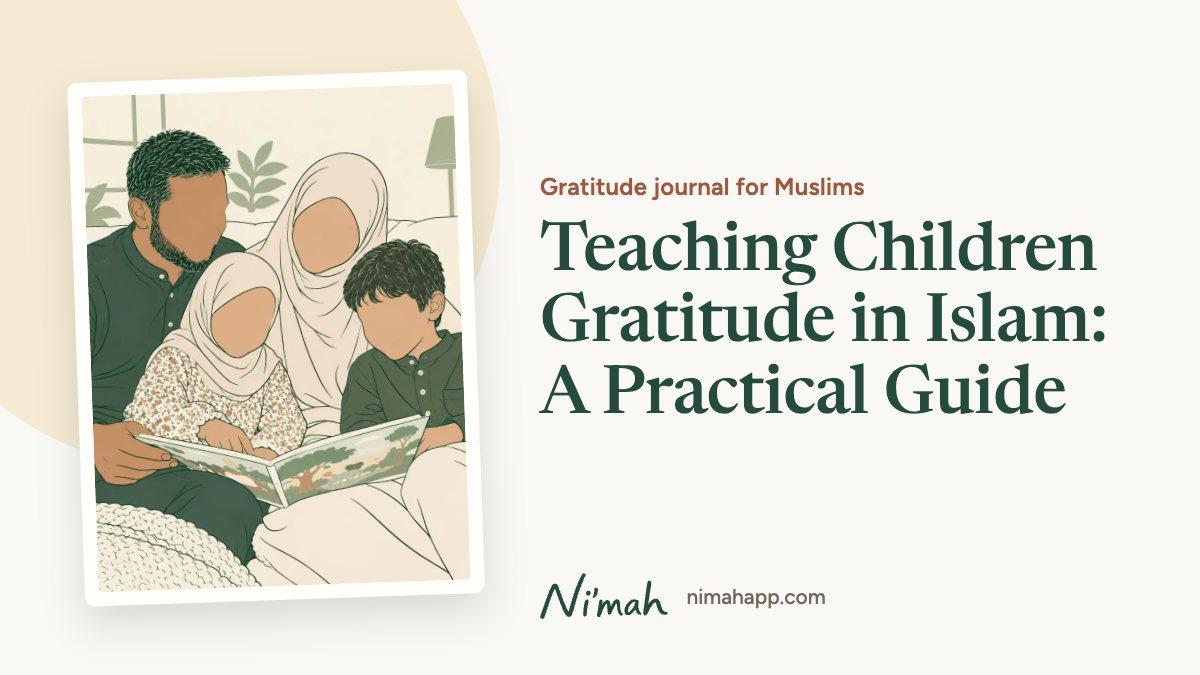
What the Quran says: Luqman’s advice
The best-known passage in the Quran about a parent teaching a child is the advice of Luqman to his son. It opens with gratitude:
And We had certainly given Luqmān wisdom [and said], ‘Be grateful to Allāh.’ And whoever is grateful is grateful for [the benefit of] himself. And whoever denies [His favor] - then indeed, Allāh is Free of need and Praiseworthy.
And [mention, O Muḥammad], when Luqmān said to his son while he was instructing him, ‘O my son, do not associate [anything] with Allāh. Indeed, association [with Him] is great injustice.’
And We have enjoined upon man [care] for his parents. His mother carried him, [increasing her] in weakness upon weakness, and his weaning is in two years. Be grateful to Me and to your parents; to Me is the [final] destination.
Two things stand out for a parent. First, Luqman was told to be grateful himself before the Quran mentions him teaching his son. Second, the verse joins gratitude to Allah with gratitude to parents. A child can understand both from an early age: Allah gave us this, and Mama and Baba took care of it.
Three small habits from the Sunnah
The Sunnah gives three habits that are simple enough for a small child. None of them needs a lesson. They happen at the table and at the door.
1. Begin with Allah’s name
The Prophet ﷺ taught this to a child directly, at a meal, in one sentence:
‘Umar ibn Abi Salamah said that he was a boy in the care of the Prophet ﷺ and his hand used to wander around the dish. The Prophet ﷺ told him to mention the name of Allah, to eat with his right hand and to eat from what was nearest to him. He said that he ate that way from then on.
Saying “Bismillah” before eating reminds a child where the food comes from before the first bite.
2. Praise Allah after eating and drinking
The Prophet ﷺ said that Allah is pleased with a servant who eats something and praises Him for it, or drinks something and praises Him for it.
“Alhamdulillah” after a meal or a glass of water is short enough for a small child to say. Say it out loud yourself, and let your child hear it every day.
3. Thank people
The Prophet ﷺ said that whoever does not thank people does not thank Allah.
So thanking Allah and thanking people belong together. Let your child hear you thank the bus driver, the grandmother who cooked and the sibling who shared. Thank your child, too, when they help.
Ideas by age
The ideas in this table are our own suggestions, not something taken from the sources above. Every child is different, so take what fits your family and leave the rest.
| Age | What a child can do | What you can do |
|---|---|---|
| About 3–5 | Say “Bismillah” and “Alhamdulillah” at meals. Point to one thing they like and say “Alhamdulillah” for it. Say thank you when given something. | Say the words out loud yourself. Name blessings in passing: “Alhamdulillah for the rain.” Keep it playful and short. |
| About 6–9 | Name three things they thank Allah for at bedtime. Draw a blessing or write one line about it. Thank a person by name for something specific. | Ask “Why are you glad about that?” Share your own three things. Tell the story of Luqman and his son in simple words. |
| About 10+ | Keep a short gratitude journal of their own. Write a thank-you note to a grandparent or teacher. Make dua for the people they are grateful for. | Give them privacy for their journal. Talk about hard days too, and what was still good in them. Read Surah Luqman 31:12–14 together. |
A two-minute bedtime habit: three things we thank Allah for today
If you only take one idea from this post, take this one. It needs no material and fits between brushing teeth and lights out.
Sit down together.
On the edge of the bed, lights low, phone away. Same place and same time every night.
Ask one question.
“What are three things we thank Allah for today?” Use the same words each night so your child knows what is coming.
Go first.
Name one small, specific thing: “Alhamdulillah that we ate together.” Your child hears how it is done.
Let your child name theirs.
Accept whatever comes, even if it is the same toy three nights in a row. Do not correct the answers.
Close with “Alhamdulillah” and a short dua.
Say “Alhamdulillah” together. If you like, add the dua for your family below.
Some nights it takes thirty seconds and some nights your child will not feel like it. That is fine. Say your own three things and try again tomorrow.
A dua for your family
Teaching is your part. For everything else, ask Allah. The Quran describes the servants of the Most Merciful as people who make this dua:
رَبَّنَا هَبْ لَنَا مِنْ أَزْوَٰجِنَا وَذُرِّيَّـٰتِنَا قُرَّةَ أَعْيُنٍ وَٱجْعَلْنَا لِلْمُتَّقِينَ إِمَامًا
Rabbana hab lana min azwajina wa dhurriyyatina qurrata a‘yunin waj‘alna lil-muttaqina imama.
Our Lord, grant us from among our wives and offspring comfort to our eyes and make us a leader [i.e., example] for the righteous.
When your child does not seem grateful
Children complain, forget to say thank you and want more. That does not mean your effort is wasted. Keep the habits small and regular, keep saying the words yourself and avoid turning gratitude into a punishment (“You should be grateful!”). Nobody can promise how a child will turn out. What you can do is show gratitude every day and make dua.
Keeping your child’s moments
Your own gratitude journal is part of this. When your child sees you write down three blessings each evening, the bedtime question stops being a rule only for children.
Ni’mah is a Muslim gratitude journal for iPhone that we built for Muslim families. You write down what you are grateful for each day, and a reminder helps you keep the habit. Your memories are stored on your iPhone and, with iCloud sync, in your private iCloud. If you like, a photo becomes an illustration in which faces are not recognizable.
For parents, that means: you can keep your child’s moments, the first “Alhamdulillah”, a drawing or a day out, as illustrations without recognizable faces.
Without a subscription, the gratitude journal, reminders, Love Notes, widgets and 1 illustration per month are included. Ni’mah Pro gives you a larger illustration allowance.
Ni’mah is our own app.
Download Ni’mah on the App Store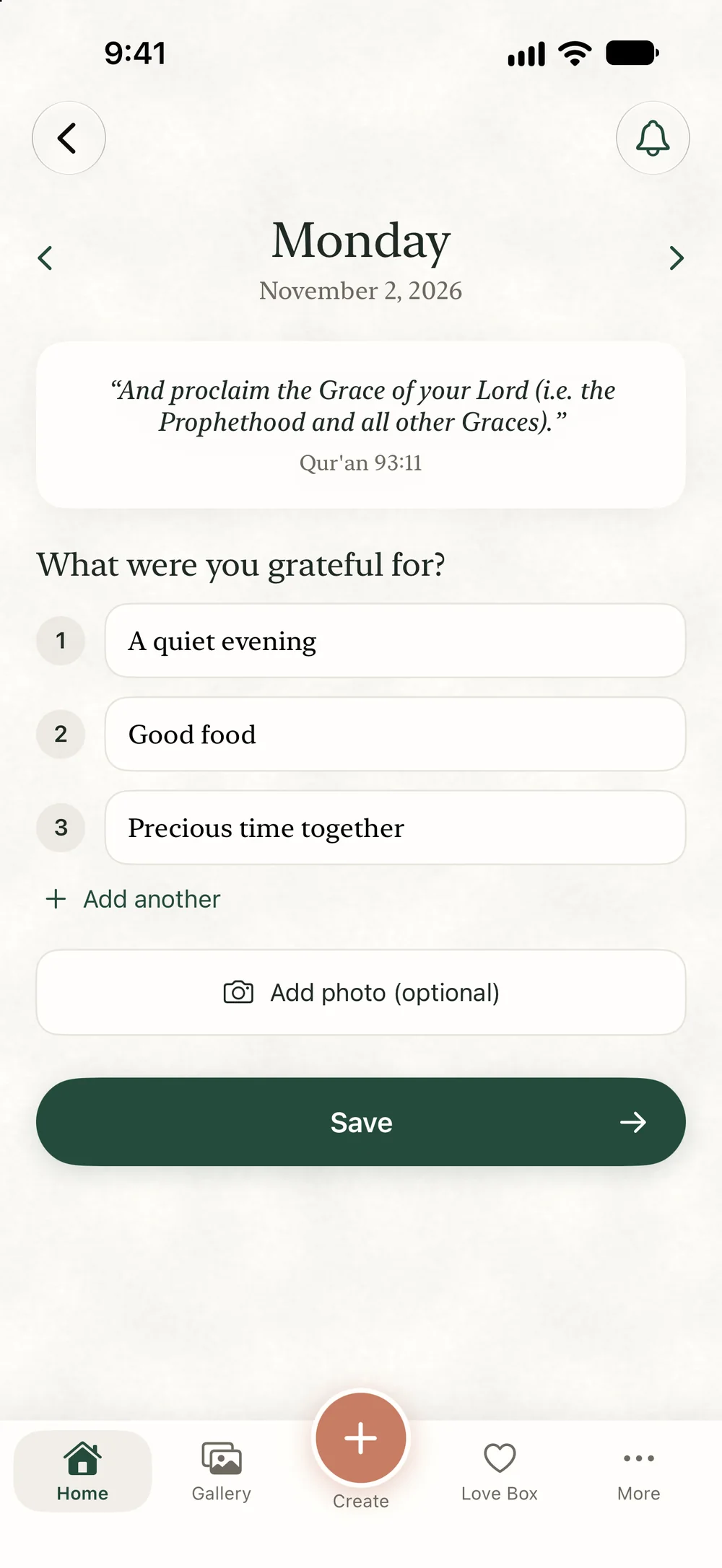
Start tonight at bedtime
Sit down with your child for two minutes and ask: “What are three things we thank Allah for today?” Go first, keep it small and say “Alhamdulillah” together. Do it again tomorrow.
Keep your family’s blessings in Ni’mahFrequently asked questions
- How do I teach my child to be grateful to Allah?
- Make it part of ordinary moments: “Bismillah” before eating, “Alhamdulillah” after, thanking people out loud and naming three blessings together before sleep. Say the words yourself first; your child learns them by hearing them.
- What does the Quran say about teaching children gratitude?
- In Surah Luqman, Allah says He gave Luqman wisdom and told him: “Be grateful to Allāh” (31:12). Two verses later, in the same passage as Luqman’s advice to his son, comes: “Be grateful to Me and to your parents” (31:14).
- At what age can a child start?
- As soon as a child can repeat words, they can say “Bismillah” and “Alhamdulillah” with you. Naming three blessings at bedtime works for many children from about school age. These are our suggestions; adjust them to your child.
- Which dua can I make for my children?
- The Quran gives this dua in Surah al-Furqan 25:74: “Our Lord, grant us from among our wives and offspring comfort to our eyes and make us a leader [i.e., example] for the righteous.” You can also ask in your own words, in any language.
- What if my child refuses to join in?
- Do not force it. Say your own three things out loud and try again the next evening. Keep it short and friendly, and do not use gratitude as a reproach.
- Is Ni’mah free?
- Yes, Ni’mah can be used without a subscription: the gratitude journal, reminders, Love Notes, widgets and 1 illustration per month are included. Ni’mah Pro offers a larger illustration allowance; with the yearly plan, two people can use Ni’mah Together.
Sources
- Surah al-Furqan 25:74, Saheeh International (quran.com)
- Surah Luqman 31:12, Saheeh International (quran.com)
- Surah Luqman 31:13, Saheeh International (quran.com)
- Surah Luqman 31:14, Saheeh International (quran.com)
- Sahih al-Bukhari, no. 5376 (sunnah.com)
- Sahih Muslim, no. 2734a (sunnah.com)
- Jami‘ at-Tirmidhi, no. 1954 (sunnah.com)
Read also
Related guides
- Free Printable Gratitude Journal for Muslims: 30 Days of Shukr (PDF)
Download a free 30-day shukr journal for Muslims as a printable PDF: a prompt for every day, space for three blessings, and duas for gratitude with sources.
- Muhasaba: Meaning and a Gentle Evening Routine
What muhasaba means, the Qur’an verses behind it and a gentle five-minute evening routine with example questions for taking yourself to account.
- 40 Muslim Journal Prompts for Every Kind of Day
40 simple Muslim journal prompts in five groups: gratitude, family, worship and Qur’an, hardship and patience, hopes and duas. With verses and a closing dua.
- Ramadan Journal: How to Keep One and What to Write
How to keep a Ramadan journal in five minutes a day: a simple daily page, 30 short prompts, the dua for Laylat al-Qadr and the verses behind it, with sources.
- Umrah Journal: What to Write Before, During and After the Journey
How to keep an Umrah or Hajj journal: what to write before, during and after the journey, prompts for Makkah and Madinah, and a dua list. With sources.
About the author
Mustafa Ali
Mustafa Ali lives in Medina, the City of the Prophet ﷺ, where he studies Islamic sciences. He built Ni’mah as an Islamic photo app that shows no faces, so families can keep their memories without exposing them to the evil eye and envy.