Shukr Journal: How to Keep a Muslim Gratitude Journal
By Mustafa Ali
In short
Each day, write down three specific blessings and add one sentence on why you are grateful for each. Five minutes after Isha or before bed is enough. Below you will find what shukr means, the steps, example entries, 30 prompts and two duas for gratitude.
A shukr journal is a Muslim gratitude journal: a short daily note of the blessings you are grateful for. Shukr is the Arabic word for gratitude, and for a Muslim it means recognising that every blessing comes from Allah, saying “Alhamdulillah” and using the blessing well. To start, write down three blessings a day, however small, and why each one matters to you.
Get Ni’mah on the App Store
What does shukr mean?
Shukr (شكر) is the Arabic word for gratitude or thankfulness. In Islam it means being grateful to Allah for His blessings.
Shukr is commonly described on three levels. It begins in the heart, when you recognise that a blessing comes from Allah. It is spoken with the tongue, when you say “Alhamdulillah” (all praise is for Allah). And it shows in what you do with the blessing. Each blessing is called a ni‘mah in Arabic.
So remember Me; I will remember you. And be grateful to Me and do not deny Me.
What is a shukr journal?
A shukr journal is a notebook or note where you write down what you are grateful for, not everything that happened that day.
The difference from an ordinary diary is the focus. A diary records events. A Muslim gratitude journal looks for the blessings inside them: your child’s laugh, enough to eat, a dua that was answered or simply a calm evening. Because it is short, it is easy to keep up every day. Some people call it an Islamic journal or a Muslim journal; the idea is the same.
Gratitude journaling in Islam
There is no set form for a gratitude journal in the Quran or the Sunnah, but remembering and mentioning the blessings of Allah is encouraged.
A shukr journal helps with the first two levels of shukr: you pause, you notice the blessing and you put it into words.
And [remember] when your Lord proclaimed, ‘If you are grateful, I will surely increase you [in favor]; but if you deny, indeed, My punishment is severe.’
But as for the favor of your Lord, report [it].
The Prophet ﷺ said how wonderful the affair of the believer is: all of it is good for him. If something pleasing happens to him, he is grateful, and that is good for him; if hardship reaches him, he is patient, and that is good for him.
How to keep a shukr journal in 5 steps
You need five minutes and somewhere to write.
Pick a fixed time.
For example after Isha or before you go to sleep. The same time every day makes the habit easier to keep.
Choose where you write.
A small notebook, the notes on your phone or a journal app. What matters is that it is close at hand and belongs only to you.
Write three specific blessings.
Instead of “my family”, write “My mother called to ask how I was.” Specific blessings can be felt again when you read them later.
Add why you are grateful.
One sentence is enough: why did this blessing matter to you today? This is where gratitude is felt, not only listed.
Close with a dua.
The Prophet ﷺ taught the dua below to Mu‘adh ibn Jabal and advised him to say it at the end of every prayer. It also suits the end of a journal entry.
Result: in five minutes you have a daily record of blessings that you can read again whenever you like.
Duas for gratitude (shukr ki dua)
If you are looking for a dua of shukr, in Urdu often searched as “shukr ki dua” or “Allah ka shukar ki dua”, these two are well sourced: one from the Sunnah and one from the Quran.
اللَّهُمَّ أَعِنِّي عَلَى ذِكْرِكَ وَشُكْرِكَ وَحُسْنِ عِبَادَتِكَ
Allahumma a‘inni ‘ala dhikrika wa shukrika wa husni ‘ibadatik.
O Allah, help me to remember You, to thank You and to worship You well.
رَبِّ أَوْزِعْنِىٓ أَنْ أَشْكُرَ نِعْمَتَكَ ٱلَّتِىٓ أَنْعَمْتَ عَلَىَّ وَعَلَىٰ وَٰلِدَىَّ وَأَنْ أَعْمَلَ صَـٰلِحًا تَرْضَىٰهُ وَأَدْخِلْنِى بِرَحْمَتِكَ فِى عِبَادِكَ ٱلصَّـٰلِحِينَ
Rabbi awzi‘ni an ashkura ni‘mataka allati an‘amta ‘alayya wa ‘ala walidayya wa an a‘mala salihan tardahu wa adkhilni bi-rahmatika fi ‘ibadika as-salihin.
My Lord, enable me to be grateful for Your favor which You have bestowed upon me and upon my parents and to do righteousness of which You approve. And admit me by Your mercy into [the ranks of] Your righteous servants.
Shukr journal examples
On an ordinary day, a page of your gratitude journal could look like this:
| Today’s blessing | Why I am grateful |
|---|---|
| The children woke up without a fuss. | The morning was calm and we had breakfast together. |
| My husband brought me a cup of tea. | This small gesture made me feel cared for. |
| I prayed Maghrib on time. | After a busy day my heart felt lighter. |
An example for a hard day
On some days it is hard to find anything to be grateful for. Then keep it simple and honest:
- I woke up in good health this morning.
- I have a friend who listens to me.
- Allah gave me the chance to be patient.
The hadith above is a reminder: in hard times, patience is also good for the believer.
30 shukr journal prompts
Not sure what to write? Pick one of these gratitude journal prompts for Muslims and answer it in a sentence or two. They also work as Islamic diary ideas for a week or a month.
Faith and yourself
- Which blessing of faith did you feel most this week?
- Which dua that you once made has been answered?
- Which act of worship gave you the most peace today?
- Which of your abilities do you take for granted?
- Which part of your body helped you most today?
- Which mistake taught you something valuable?
Family and loved ones
- Which moment with your family today do you want to remember?
- Who made you smile today, and what did they do?
- Which small habit of your spouse are you grateful for?
- What did you learn from the children around you today?
- Which advice from your parents do you still follow?
- Who makes dua for you without being asked?
Small everyday blessings
- Which meal did you enjoy most today?
- Where did you feel most at peace today?
- Which simple thing in your home makes your life easier?
- Which sound, smell or view made you glad today?
- Which provision reached you this week that you did not expect?
- How much free time did you have today, and what did you use it for?
Hard days
- What is still good on this hard day?
- Who helped you in your last difficulty?
- What did this week’s problem teach you?
- Which hardship that you once feared have you come through?
- What kept you hopeful in Allah today?
- Which small kindness can you be grateful for in the middle of tiredness?
Others and sharing
- Whose kindness have you not yet thanked them for?
- Who would you like to thank this week?
- Which good deed can you do for someone else today?
- Which teacher’s knowledge still helps you?
- Which neighbour or friend makes your surroundings better?
- Which blessing can you share today, even a small one?
A shukr journal in Ramadan
Ramadan is a natural time to start. The verse about the month of fasting itself ends with gratitude:
Allāh intends for you ease and does not intend for you hardship and [wants] for you to complete the period and to glorify Allāh for that [to] which He has guided you; and perhaps you will be grateful.
A simple way to do it: write your three blessings after iftar or after Taraweeh, one line each. After thirty days you have about ninety blessings from a single month to read on Eid.
Paper journal or app?
Both work. Choose the one you will actually open every day.
A paper journal gives you a break from the screen and feels personal. An app is more practical if your phone is always with you: it reminds you, keeps your notes in order and lets you add photos.
Ni’mah is a Muslim gratitude journal for iPhone that we built for Muslim families. You write down what you are grateful for each day, and a reminder helps you keep the habit. Your memories are stored on your iPhone and, with iCloud sync, in your private iCloud. If you like, a photo becomes an illustration in which faces are not recognizable.
Without a subscription, the gratitude journal, reminders, Love Notes, widgets and 1 illustration per month are included. Ni’mah Pro gives you a larger illustration allowance.
Ni’mah is our own app.
Download Ni’mah on the App Store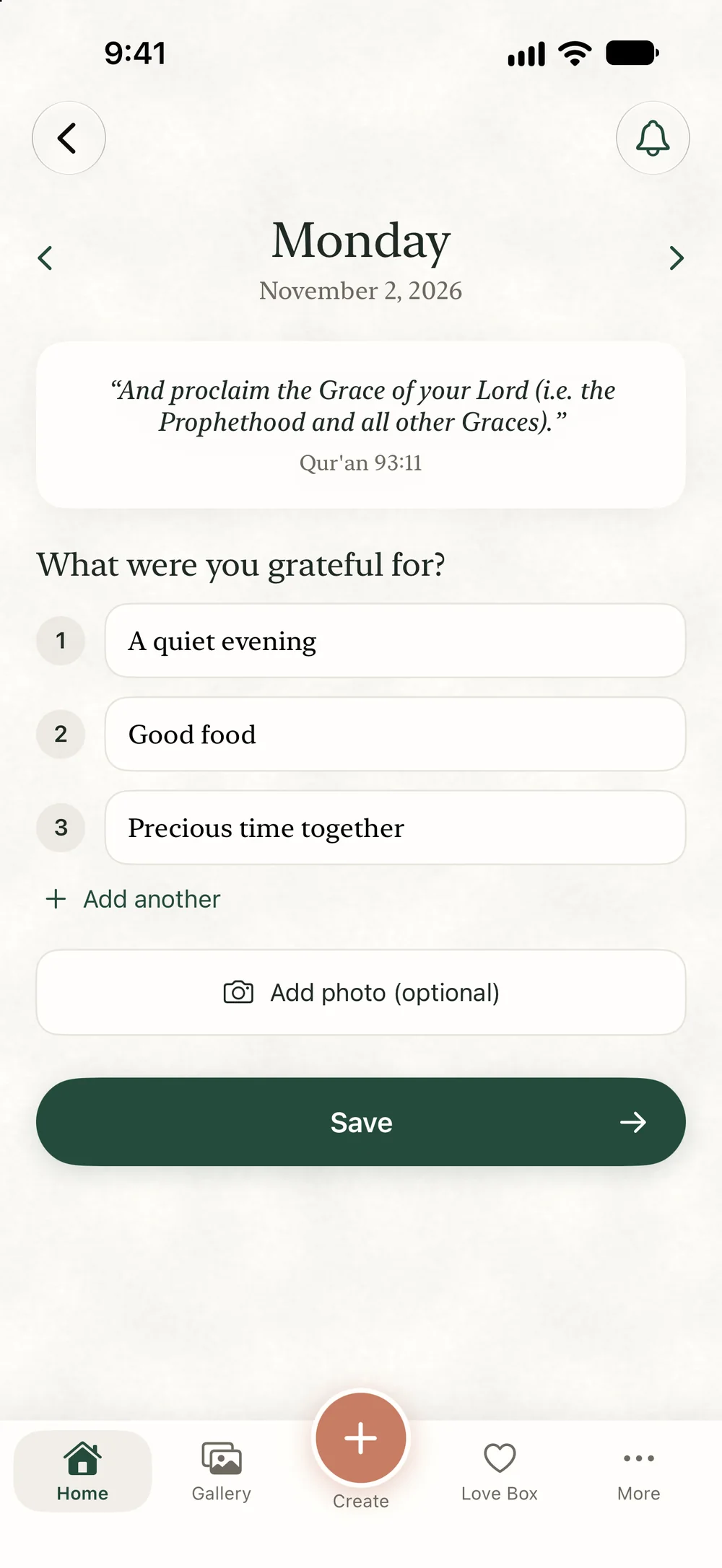
All guides on this topic
- Free Printable Gratitude Journal for Muslims: 30 Days of Shukr (PDF)
Download a free 30-day shukr journal for Muslims as a printable PDF: a prompt for every day, space for three blessings, and duas for gratitude with sources.
- Muhasaba: Meaning and a Gentle Evening Routine
What muhasaba means, the Qur’an verses behind it and a gentle five-minute evening routine with example questions for taking yourself to account.
- 40 Muslim Journal Prompts for Every Kind of Day
40 simple Muslim journal prompts in five groups: gratitude, family, worship and Qur’an, hardship and patience, hopes and duas. With verses and a closing dua.
- Ramadan Journal: How to Keep One and What to Write
How to keep a Ramadan journal in five minutes a day: a simple daily page, 30 short prompts, the dua for Laylat al-Qadr and the verses behind it, with sources.
- Teaching Children Gratitude in Islam
How to teach a child to be grateful to Allah: Luqman’s advice, three small Sunnah habits, ideas by age and a two-minute bedtime routine. With sources.
- Umrah Journal: What to Write Before, During and After the Journey
How to keep an Umrah or Hajj journal: what to write before, during and after the journey, prompts for Makkah and Madinah, and a dua list. With sources.
Start tonight
You do not need a special notebook or a lot of time. Tonight, write down three blessings and one reason for each. Do it again tomorrow. Within a few weeks you will have a record of blessings you might otherwise have overlooked.
Start your shukr journal in Ni’mahFrequently asked questions
- What does shukr mean in Islam?
- Shukr is the Arabic word for gratitude. In Islam it means being grateful to Allah: recognising in the heart that a blessing comes from Him, saying “Alhamdulillah” and using the blessing well. In the Quran, Allah says: “And be grateful to Me and do not deny Me” (2:152).
- Is keeping a gratitude journal part of Islam?
- The Quran and the Sunnah do not prescribe a gratitude journal in any set form. Mentioning the blessings of Allah is encouraged, though: Surah ad-Duha 93:11 says, “But as for the favor of your Lord, report [it].” A shukr journal is one way to do that.
- What is the dua for shukr (shukr ki dua)?
- A well-known dua is “Allahumma a‘inni ‘ala dhikrika wa shukrika wa husni ‘ibadatik”: “O Allah, help me to remember You, to thank You and to worship You well” (Abu Dawud, no. 1522). The Quran also gives the dua of Sulayman in Surah an-Naml 27:19.
- How much should I write each day?
- Three blessings are enough. Short, specific and regular is better than long and occasional.
- What do I write on a hard day?
- Keep it simple and honest: your health, someone who helped you or the chance to be patient. The Prophet ﷺ taught that for a believer both gratitude in good times and patience in hard times are good (Sahih Muslim, no. 2999).
- Is Ni’mah free?
- Yes, Ni’mah can be used without a subscription: the gratitude journal, reminders, Love Notes, widgets and 1 illustration per month are included. Ni’mah Pro offers a larger illustration allowance; with the yearly plan, two people can use Ni’mah Together.
Sources
- Surah al-Baqarah 2:152, Saheeh International (quran.com)
- Surah al-Baqarah 2:185, Saheeh International (quran.com)
- Surah Ibrahim 14:7, Saheeh International (quran.com)
- Surah an-Naml 27:19, Saheeh International (quran.com)
- Surah ad-Duha 93:11, Saheeh International (quran.com)
- Sahih Muslim, no. 2999 (sunnah.com)
- Sunan Abi Dawud, no. 1522 (sunnah.com)
Read also
About the author
Mustafa Ali
Mustafa Ali lives in Medina, the City of the Prophet ﷺ, where he studies Islamic sciences. He built Ni’mah as an Islamic photo app that shows no faces, so families can keep their memories without exposing them to the evil eye and envy.