Muhasaba: Meaning and a Gentle Evening Routine
By Mustafa Ali
In short
Muhasaba means taking yourself to account: looking honestly at your day before Allah. Its basis is Surah al-Hashr 59:18, which asks every soul to look at what it has put forth for tomorrow. Five quiet minutes in the evening are enough: thank, ask forgiveness, choose one thing for tomorrow.
Muhasaba (محاسبة) is Arabic for taking account, and in Islam it means taking yourself to account: looking back at what you did, said and intended, and setting it right with Allah. The Qur’an asks for this in Surah al-Hashr 59:18: “let every soul look to what it has put forth for tomorrow”. In practice it is a short, honest look at your day: what went well, what went wrong and what you will do tomorrow.
Get Ni’mah on the App Store
What does muhasaba mean?
Muhasaba (محاسبة, also written muhasabah) comes from the same Arabic root as hisab, which means account or reckoning. Muhasaba is the act of taking someone to account.
When Muslims speak of muhasaba, they usually mean muhasabat an-nafs: taking your own self to account. You are both the one who asks and the one who answers. You look at your day the way a shopkeeper looks at the till in the evening: what came in, what went out and what needs to change tomorrow.
It is not the same as blaming yourself. The aim is to see clearly, thank Allah for the good, turn back to Him for the rest and go on.
Muhasaba in the Qur’an
The verse most often connected with muhasaba is in Surah al-Hashr. It speaks to the believers and asks every soul to look at what it has prepared for tomorrow.
O you who have believed, fear Allāh. And let every soul look to what it has put forth for tomorrow - and fear Allāh. Indeed, Allāh is Aware of what you do.
The verse that follows describes the opposite: people who forgot Allah and so lost sight of themselves.
And be not like those who forgot Allāh, so He made them forget themselves. Those are the defiantly disobedient.
Read together, the two verses link remembering Allah with knowing yourself. Looking at your own day is a way of not forgetting either.
The Qur’an also mentions the soul that reproaches, in Arabic an-nafs al-lawwamah. Allah swears by it at the start of Surah al-Qiyamah:
And I swear by the reproaching soul [to the certainty of resurrection].
These verses ask you to look. They do not set a fixed form or a fixed time for doing it. The routine below is our suggestion for putting the verse into practice; it is not a prescribed act of worship.
How to do muhasaba: a five-minute evening routine
Pick a quiet moment at the end of the day, for example after Isha or just before you sleep. You need about five minutes, one minute for each step.
Sit down and set your intention.
Put the phone aside or open your journal. Remind yourself why you are doing this: to look at your day honestly before Allah, as 59:18 asks.
Start with what went well, and give thanks.
Name two or three good things from today: a prayer on time, a kind word, patience in a hard moment. Say “Alhamdulillah” for each. Starting with thanks keeps the look back fair.
Look at what went wrong, and ask forgiveness.
Name one or two things plainly, without excuses and without harshness: a prayer you delayed, a sharp answer, time you wasted. Say “Astaghfirullah” (I ask Allah for forgiveness). If you wronged a person, note that you will put it right with them.
Choose one thing for tomorrow.
One, not five. Make it small and specific: “I will pray Fajr before I look at my phone” or “I will call my mother.” This is the part of the verse about tomorrow.
Close with a short dua and let the day go.
Ask Allah in your own words to accept the good, forgive the rest and help you tomorrow. Then stop. The account for today is closed.
Result: in five minutes you have thanked Allah, asked His forgiveness and decided on one clear step for the next day.
Muhasaba questions for the evening
You do not need to answer all of these. Pick one from each area, or use only the two or three that speak to you tonight.
| Area | Question for tonight |
|---|---|
| Prayer | Which prayer today had most of my attention, and which had least? |
| Qur’an and remembrance | Did I read or listen to any Qur’an today, even one verse? |
| Tongue | Is there something I said today that I would take back? |
| Family | Who at home needed me today, and was I there for them? |
| Other people | Did I wrong anyone today, and how can I put it right? |
| Time | Which hour today am I glad about, and which one slipped away? |
| Blessings | Which three blessings from today do I want to thank Allah for? |
| Tomorrow | What is the one thing I will do differently tomorrow? |
Keeping it gentle
Muhasaba is a look at your day, not a verdict on yourself. A few habits help it stay that way.
- Begin with thanks every time. On a hard day, one blessing is enough.
- Name what you did, not what you “are”. Write “I snapped at my son”, not “I am a bad parent.”
- Keep the list of faults short. One or two honest lines are more useful than a long page.
- Always end with one step for tomorrow and a dua. Do not end on the mistake.
- If you miss an evening, simply start again the next one. There is nothing to catch up on.
Muhasaba and gratitude belong together
A gratitude journal looks at what Allah gave you today. Muhasaba looks at what you did with it. Written on the same page, three blessings and one thing to improve give you a balanced picture of the day.
Writing your muhasaba down
You can do muhasaba in your head, but writing two or three lines makes it easier to stay honest and to see after a few weeks what has changed. A notebook works. So does a journal app, if your phone is what you have with you in the evening.
Ni’mah is a Muslim gratitude journal for iPhone that we built for Muslim families. You write down what you are grateful for each day, and a reminder helps you keep the habit. Your memories are stored on your iPhone and, with iCloud sync, in your private iCloud. If you like, a photo becomes an illustration in which faces are not recognizable.
Without a subscription, the gratitude journal, reminders, Love Notes, widgets and 1 illustration per month are included. Ni’mah Pro gives you a larger illustration allowance.
Ni’mah is our own app.
Download Ni’mah on the App Store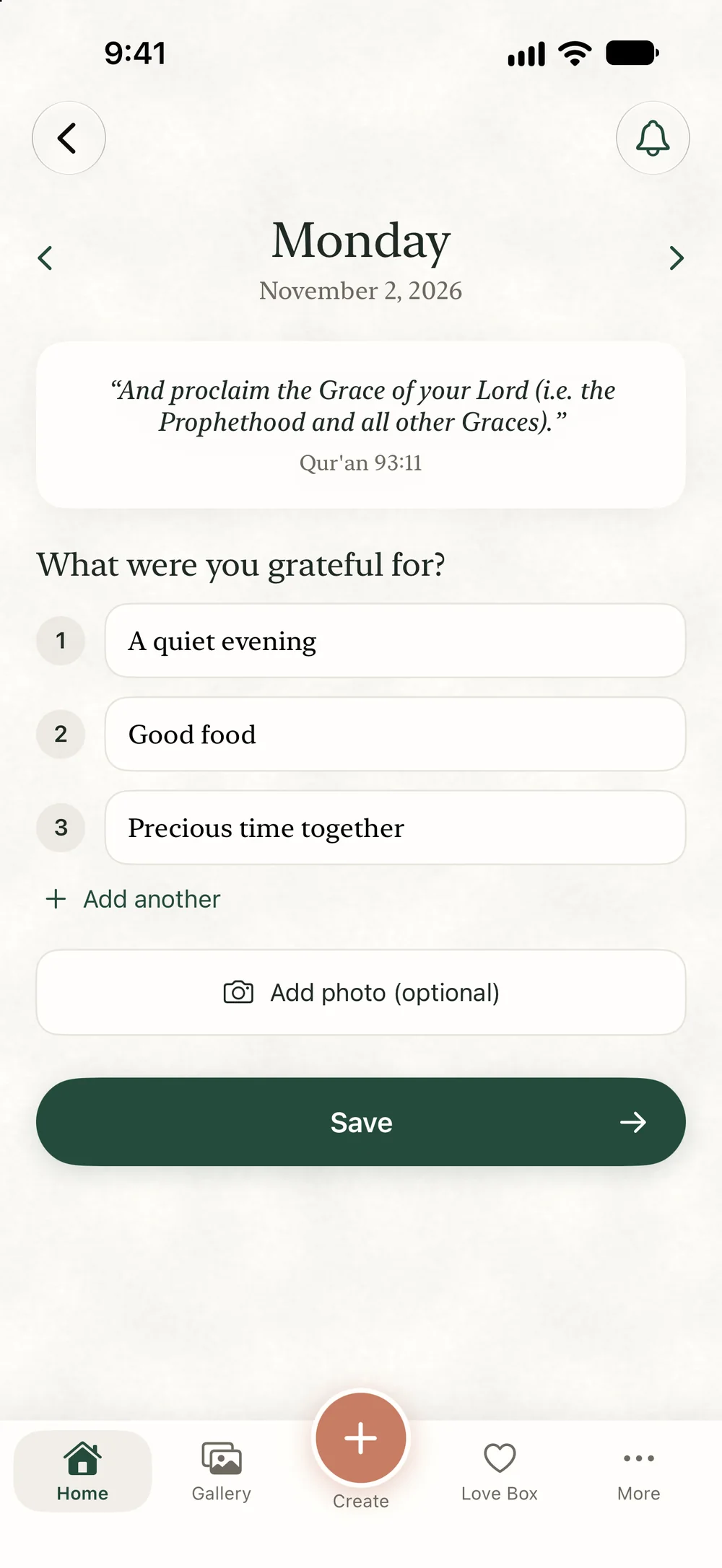
Try it tonight
Before you sleep, take five minutes. Thank Allah for two good things from today, ask forgiveness for one thing that went wrong and choose one small step for tomorrow. Write it down if you can.
Start your journal in Ni’mahFrequently asked questions
- What does muhasaba mean?
- Muhasaba is an Arabic word from the same root as hisab (account, reckoning). It means taking to account. In Islam it usually refers to muhasabat an-nafs: taking yourself to account by looking honestly at your deeds, words and intentions.
- Where is muhasaba mentioned in the Qur’an?
- The word itself is not the wording of the verse, but the idea is in Surah al-Hashr 59:18: “And let every soul look to what it has put forth for tomorrow”. The next verse, 59:19, warns against being like those who forgot Allah, “so He made them forget themselves.”
- When is the best time for muhasaba?
- The verses do not name a time. Many people find the evening practical, after Isha or before sleep, because the day is complete and the house is quiet. Choose a time you can keep every day.
- How long should muhasaba take?
- Five minutes are enough for a daily look back: thanks, asking forgiveness and one step for tomorrow. Short and regular is easier to keep than long and rare.
- Is muhasaba the same as feeling guilty?
- No. Muhasaba means seeing your day clearly and turning back to Allah. In the routine above, it starts with thanks, names mistakes plainly and briefly, and ends with asking forgiveness and one step for tomorrow.
- Is Ni’mah free?
- Yes, Ni’mah can be used without a subscription: the gratitude journal, reminders, Love Notes, widgets and 1 illustration per month are included. Ni’mah Pro offers a larger illustration allowance; with the yearly plan, two people can use Ni’mah Together.
Sources
- Surah al-Hashr 59:18, Saheeh International (quran.com)
- Surah al-Hashr 59:19, Saheeh International (quran.com)
- Surah al-Qiyamah 75:2, Saheeh International (quran.com)
Read also
Related guides
- Free Printable Gratitude Journal for Muslims: 30 Days of Shukr (PDF)
Download a free 30-day shukr journal for Muslims as a printable PDF: a prompt for every day, space for three blessings, and duas for gratitude with sources.
- 40 Muslim Journal Prompts for Every Kind of Day
40 simple Muslim journal prompts in five groups: gratitude, family, worship and Qur’an, hardship and patience, hopes and duas. With verses and a closing dua.
- Ramadan Journal: How to Keep One and What to Write
How to keep a Ramadan journal in five minutes a day: a simple daily page, 30 short prompts, the dua for Laylat al-Qadr and the verses behind it, with sources.
- Teaching Children Gratitude in Islam
How to teach a child to be grateful to Allah: Luqman’s advice, three small Sunnah habits, ideas by age and a two-minute bedtime routine. With sources.
- Umrah Journal: What to Write Before, During and After the Journey
How to keep an Umrah or Hajj journal: what to write before, during and after the journey, prompts for Makkah and Madinah, and a dua list. With sources.
About the author
Mustafa Ali
Mustafa Ali lives in Medina, the City of the Prophet ﷺ, where he studies Islamic sciences. He built Ni’mah as an Islamic photo app that shows no faces, so families can keep their memories without exposing them to the evil eye and envy.