Umrah Journal: What to Write Before, During and After the Journey
By Mustafa Ali
In short
Keep it short. Before you leave, write your dua list and the names of people who asked you for dua. During the journey, write three lines each evening: what you saw, what you asked Allah for and what you are grateful for. After you come home, write what you want to keep.
An Umrah journal is a small notebook or note for your journey to Makkah and Madinah. Before you leave, you write down your intentions and the duas you want to make. During the journey, you note a few lines a day about what you saw, felt and asked for. After you come home, you write what the journey changed and what you want to hold on to. The same works for Hajj.
Get Ni’mah on the App Store
Why keep an Umrah journal?
The days of Umrah and Hajj are full, and they pass quickly. A journal helps you arrive prepared and remember afterwards what you asked Allah for and what you were grateful for.
There is no set form for such a journal in the Quran or the Sunnah. What the Quran does stress, again and again in the verses about Hajj, is remembering Allah. About the people who answer the call to Hajj it says:
And proclaim to the people the ḥajj [pilgrimage]; they will come to you on foot and on every lean camel; they will come from every distant pass -
That they may witness [i.e., attend] benefits for themselves and mention the name of Allāh on known [i.e., specific] days over what He has provided for them of [sacrificial] animals. So eat of them and feed the miserable and poor.
The Prophet ﷺ also spoke about the worth of both journeys:
The Prophet ﷺ said that one Umrah to the next is an expiation for what comes between them, and that the reward of an accepted Hajj (hajj mabrur) is nothing but Paradise.
This is not a guide to the rites
This post is about what to write, not about how to perform Umrah or Hajj. For the rites themselves, follow a qualified teacher or your group’s guide.
What to write: before, during and after
Think of the journal in three parts. You do not need to fill a page a day. A few honest lines are enough.
| When | What to write | How much |
|---|---|---|
| Before the journey | Your intention, your dua list, the names of people who asked you for dua, what you hope to leave behind. | One or two pages, written once. |
| During the journey | What you saw today, what you asked Allah for, one thing you are grateful for. | Three lines each evening. |
| After the journey | What you want to keep, who you want to thank, which duas you will keep making at home. | One page in the first week, then a line whenever you remember something. |
Before you leave
This is the part people most often wish they had done. Once you are there, tiredness and crowds make it hard to remember everything you meant to ask for.
- Why are you going? Write your intention in one or two sentences.
- Which duas do you want to make for yourself: your faith, your health, your family, your provision?
- Who asked you to make dua for them? Write each name and, if they told you, what they asked for.
- Who do you want to make dua for without being asked: parents, children, teachers, people who have passed away?
- Is there someone you should ask for forgiveness, or forgive, before you go?
- Which blessings made this journey possible: money, health, time, the people looking after things at home?
Keep the dua list on its own page so you can open it quickly. Tick a name when you have made dua for that person. Later you can tell a friend, “I made dua for you there.”
The talbiyah
‘Abdullah ibn ‘Umar reported the words of the talbiyah of the Prophet ﷺ. You may want to write them on the first page of your journal:
لَبَّيْكَ اللَّهُمَّ لَبَّيْكَ، لَبَّيْكَ لاَ شَرِيكَ لَكَ لَبَّيْكَ، إِنَّ الْحَمْدَ وَالنِّعْمَةَ لَكَ وَالْمُلْكَ، لاَ شَرِيكَ لَكَ
Labbayka Allahumma labbayk, labbayka la sharika laka labbayk, inna al-hamda wan-ni‘mata laka wal-mulk, la sharika lak.
Here I am, O Allah, here I am. Here I am, You have no partner, here I am. Truly all praise and every blessing are Yours, and so is the dominion. You have no partner.
Notice the word ni‘mah in it: blessing. The talbiyah itself says that every blessing belongs to Allah. That is a good first line for a gratitude page.
In Makkah
Write in the evening, when the day is still fresh. Pick one or two of these prompts:
- What did you feel when you first saw the Ka‘bah? Write it the same day; the first impression fades fast.
- Which dua did you make today that mattered most to you?
- Whose names from your dua list did you remember today?
- What was hard today, and what helped you stay patient?
- Which stranger was kind to you, or who were you able to help?
- What is one blessing of today that you did not expect?
In Madinah
If your journey includes Madinah, the city of the Prophet ﷺ, take a little more time to write there. These prompts may help:
- What did you feel when you entered the Prophet’s Mosque?
- Which part of the life of the Prophet ﷺ came to your mind here?
- What do you want to learn about him when you are back home?
- What made today peaceful?
- Which habit do you want to take home from these days?
After coming home
The journey ends, but the remembering should not. The Quran says this to the pilgrims of Hajj directly:
And when you have completed your rites, remember Allāh like your [previous] remembrance of your fathers or with [much] greater remembrance.
And earlier in the same passage:
But when you depart from ʿArafāt, remember Allāh at al-Mashʿar al-Ḥarām. And remember Him, as He has guided you, for indeed, you were before that among those astray.
In the first week at home, before everyday life takes over again, sit down once and write:
- Which three moments of the journey do you never want to forget?
- What did you ask Allah for that you want to keep asking at home?
- Which one habit from the journey will you keep, and at what time of day?
- Who made this journey possible, and have you thanked them?
- What would you tell a friend who is about to go?
Then read your journal again after a month. The pages you wrote there will remind you of things you have already started to forget.
Practical tips
- Choose something small: a pocket notebook or the notes on your phone.
- Write at a fixed moment, for example each evening when you are back in your room.
- Three lines are enough. A journal you keep briefly every day is worth more than one you give up on day two.
- Write for yourself. Nobody else needs to read it.
Paper journal or app?
Both work. A pocket notebook needs no battery. An app is practical if your phone is with you anyway and you want your notes and photos from the journey in one place.
Ni’mah is a Muslim gratitude journal for iPhone that we built for Muslim families. You write down what you are grateful for each day, and a reminder helps you keep the habit. Your memories are stored on your iPhone and, with iCloud sync, in your private iCloud. If you like, a photo becomes an illustration in which faces are not recognizable.
For a journey like this, that means: a photo from your Umrah can become an illustration without recognizable faces, next to the lines you wrote that day.
Without a subscription, the gratitude journal, reminders, Love Notes, widgets and 1 illustration per month are included. Ni’mah Pro gives you a larger illustration allowance.
Ni’mah is our own app.
Download Ni’mah on the App Store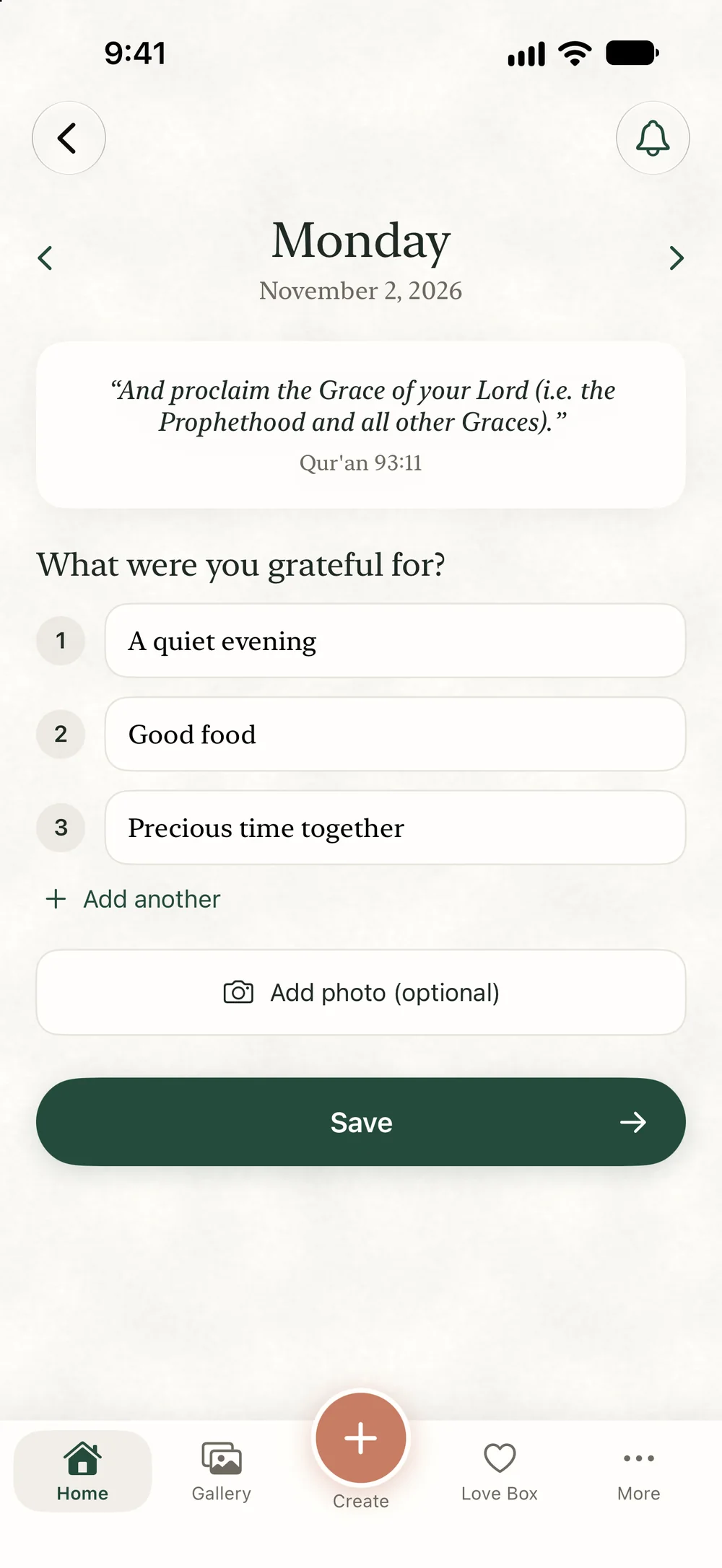
Start with your dua list
You do not have to wait for the day you travel. Tonight, write down your intention and the first five duas you want to make. Add the names of the people who ask you for dua as they come. The rest of the journal will follow from there.
Keep your Umrah journal in Ni’mahFrequently asked questions
- What do you write in an Umrah journal?
- Before the journey: your intention, your dua list and the names of people who asked you for dua. During the journey: a few lines each evening about what you saw, what you asked Allah for and what you are grateful for. After the journey: what you want to keep.
- Is keeping an Umrah or Hajj journal part of the Sunnah?
- No set form of journal is prescribed in the Quran or the Sunnah. It is a personal tool. What the Quran stresses in the verses about Hajj is remembering Allah, for example in Surah al-Baqarah 2:200, and a journal can help you do that.
- How do I make a dua list for Umrah?
- Take one page. Write your own duas first, then the names of the people who asked you for dua and what each of them asked for, then the people you want to remember without being asked. Tick each name once you have made dua for that person.
- How much should I write each day?
- Three lines are enough: one thing you saw, one thing you asked for and one thing you are grateful for. The days are tiring, so keep it short and regular.
- Does this post explain how to perform Umrah?
- No. It only covers what to write. For the rites of Umrah and Hajj, follow a qualified teacher or your group’s guide.
- Is Ni’mah free?
- Yes, Ni’mah can be used without a subscription: the gratitude journal, reminders, Love Notes, widgets and 1 illustration per month are included. Ni’mah Pro offers a larger illustration allowance; with the yearly plan, two people can use Ni’mah Together.
Sources
- Surah al-Baqarah 2:198, Saheeh International (quran.com)
- Surah al-Baqarah 2:200, Saheeh International (quran.com)
- Surah al-Hajj 22:27, Saheeh International (quran.com)
- Surah al-Hajj 22:28, Saheeh International (quran.com)
- Sahih al-Bukhari, no. 1549 (sunnah.com)
- Sahih al-Bukhari, no. 1773 (sunnah.com)
Read also
Related guides
- Free Printable Gratitude Journal for Muslims: 30 Days of Shukr (PDF)
Download a free 30-day shukr journal for Muslims as a printable PDF: a prompt for every day, space for three blessings, and duas for gratitude with sources.
- Muhasaba: Meaning and a Gentle Evening Routine
What muhasaba means, the Qur’an verses behind it and a gentle five-minute evening routine with example questions for taking yourself to account.
- 40 Muslim Journal Prompts for Every Kind of Day
40 simple Muslim journal prompts in five groups: gratitude, family, worship and Qur’an, hardship and patience, hopes and duas. With verses and a closing dua.
- Ramadan Journal: How to Keep One and What to Write
How to keep a Ramadan journal in five minutes a day: a simple daily page, 30 short prompts, the dua for Laylat al-Qadr and the verses behind it, with sources.
- Teaching Children Gratitude in Islam
How to teach a child to be grateful to Allah: Luqman’s advice, three small Sunnah habits, ideas by age and a two-minute bedtime routine. With sources.
About the author
Mustafa Ali
Mustafa Ali lives in Medina, the City of the Prophet ﷺ, where he studies Islamic sciences. He built Ni’mah as an Islamic photo app that shows no faces, so families can keep their memories without exposing them to the evil eye and envy.