How to Keep the Blessings Allah Gave You
By Mustafa Ali
In short
The Qur’an links keeping a blessing to gratitude: “If you are grateful, I will surely increase you” (14:7). It also tells of peoples who denied Allah’s favors and lost them. Be grateful in heart, word and deed, thank people and ask Allah to protect what He gave you.
In the Qur’an, the way to keep a blessing is to be grateful for it. Allah promises increase to those who are grateful (14:7) and says He does not change a favor He gave a people until they change what is within themselves (8:53). The Prophet ﷺ also asked Allah for refuge from the decline of His blessing, in a dua recorded in Sahih Muslim. So a Muslim holds on to blessings with gratitude and with dua.
Get Ni’mah on the App Store
What a blessing is, and who keeps it
A blessing is called a ni‘mah in Arabic: health, family, safety, food, faith, a calm evening. In the Qur’an, blessings come from Allah, and He is the one who increases them or takes them away.
That shapes the question. “How do I keep my blessings?” is less about holding on tightly and more about how you live with what you were given. The Qur’an speaks about this in a promise, in a rule and in two stories.
The promise: gratitude and increase
The best-known verse on the subject is in Surah Ibrahim:
And [remember] when your Lord proclaimed, ‘If you are grateful, I will surely increase you [in favor]; but if you deny, indeed, My punishment is severe.’
The verse puts two paths side by side. Gratitude is tied to increase. Denying the favor is tied to a warning. The Arabic word for denying here comes from the same root as kufr; it is the opposite of shukr, gratitude.
Shukr is commonly described on three levels: recognising in the heart that the blessing is from Allah, saying “Alhamdulillah” with the tongue, and using the blessing well.
What the Qur’an says about losing blessings
The Qur’an is just as clear about the other direction. It gives a rule and then shows it in two stories.
Surah al-Anfal 8:53: the rule
That is because Allāh would not change a favor which He had bestowed upon a people until they change what is within themselves. And indeed, Allāh is Hearing and Knowing.
The verse says that a favor given to a people is not changed until they change what is within themselves. The change starts with the people, not with the favor.
Surah an-Nahl 16:112: the town that was safe
And Allāh presents an example: a city [i.e., Makkah] which was safe and secure, its provision coming to it in abundance from every location, but it denied the favors of Allāh. So Allāh made it taste the envelopment of hunger and fear for what they had been doing.
Look at what the town had: safety, calm and provision arriving from every direction. The verse names the turning point in a few words: it denied the favors of Allah. Then safety became fear and plenty became hunger.
Surah Saba’ 34:15–17: the two gardens
There was for [the tribe of] Saba’ in their dwelling place a sign: two [fields of] gardens on the right and on the left. [They were told], “Eat from the provisions of your Lord and be grateful to Him. A good land [have you], and a forgiving Lord.”
But they turned away [refusing], so We sent upon them the flood of the dam, and We replaced their two [fields of] gardens with gardens of bitter fruit, tamarisks and something of sparse lote trees.
The people of Saba’ were given gardens on both sides and one instruction: eat, and be grateful. They turned away, and the gardens were replaced with bitter fruit and a few sparse trees. The next verse, 34:17, says this was their repayment because they disbelieved.
| Verse | What it describes | What it says |
|---|---|---|
| 14:7 | What your Lord proclaimed | Gratitude is met with increase; denial with a warning. |
| 8:53 | A favor from Allah | It is not changed until the people change what is within themselves. |
| 16:112 | Safety and provision from everywhere | The town denied the favors and tasted hunger and fear. |
| 34:15–17 | Two fields of gardens | They turned away; the gardens were replaced with bitter fruit. |
A word of care
These verses are a reminder for yourself. They speak about peoples who denied Allah’s favors. They are not a way to judge why you or someone else lost a job, health or a loved one. For the believer, the Prophet ﷺ described both states as good:
The Prophet ﷺ said how wonderful the affair of the believer is: all of it is good for him. If something pleasing happens to him, he is grateful, and that is good for him; if hardship reaches him, he is patient, and that is good for him.
A dua for refuge from the decline of blessings
The Prophet ﷺ did not only teach gratitude. He also asked Allah to protect what He had given. ‘Abdullah ibn ‘Umar reported that this was among his supplications:
اللَّهُمَّ إِنِّي أَعُوذُ بِكَ مِنْ زَوَالِ نِعْمَتِكَ وَتَحَوُّلِ عَافِيَتِكَ وَفُجَاءَةِ نِقْمَتِكَ وَجَمِيعِ سَخَطِكَ
Allahumma inni a‘udhu bika min zawali ni‘matika wa tahawwuli ‘afiyatika wa fuja’ati niqmatika wa jami‘i sakhatik.
O Allah, I seek refuge in You from the decline of Your blessing, from the change of the well-being You have given, from Your sudden punishment and from all that displeases You.
The dua names four things: a blessing fading away, well-being turning into its opposite, sudden punishment and anything that displeases Allah. You can say it in the morning, after a prayer or whenever you notice how much you have.
Thanking people is part of thanking Allah
Most blessings reach you through someone: a mother who cooked, a colleague who covered for you, a stranger who held the door. The Sunnah connects the two kinds of thanks:
The Prophet ﷺ said that whoever is not grateful to people is not grateful to Allah.
So thanking people is not a distraction from shukr. A message, a phone call or a sincere thank-you belongs to it.
Five habits for holding on to blessings
These are our own practical suggestions for living the verses above. They are not taken from the sources as a method, and none of them guarantees an outcome. What Allah gives and keeps is His decision.
Name three blessings a day.
Write them down or say them out loud, and say “Alhamdulillah” for each. A blessing you have named is harder to take for granted.
Use the blessing for something good.
Ask of one blessing each day: what is this for? Free time, health and money can each be spent on something you would be glad to remember.
Thank one person.
Pick someone a blessing came through today and tell them, specifically. “Thank you for picking up the children” says more than “thanks for everything”.
Say the dua of refuge.
Add the dua from Sahih Muslim above to a fixed moment in your day, for example after Fajr, so it does not depend on remembering.
Look back once a week.
Read what you wrote in the last seven days. Blessings that felt small on the day often look larger from a distance.
A place to write your blessings down
The first habit needs somewhere to write. A notebook works. An app is practical if your phone is always with you: it reminds you and keeps your entries in order, so you can read them again at the end of the week.
Ni’mah is a Muslim gratitude journal for iPhone that we built for Muslim families. You write down what you are grateful for each day, and a reminder helps you keep the habit. Your memories are stored on your iPhone and, with iCloud sync, in your private iCloud. If you like, a photo becomes an illustration in which faces are not recognizable.
Without a subscription, the gratitude journal, reminders, Love Notes, widgets and 1 illustration per month are included. Ni’mah Pro gives you a larger illustration allowance.
Ni’mah is our own app.
Download Ni’mah on the App Store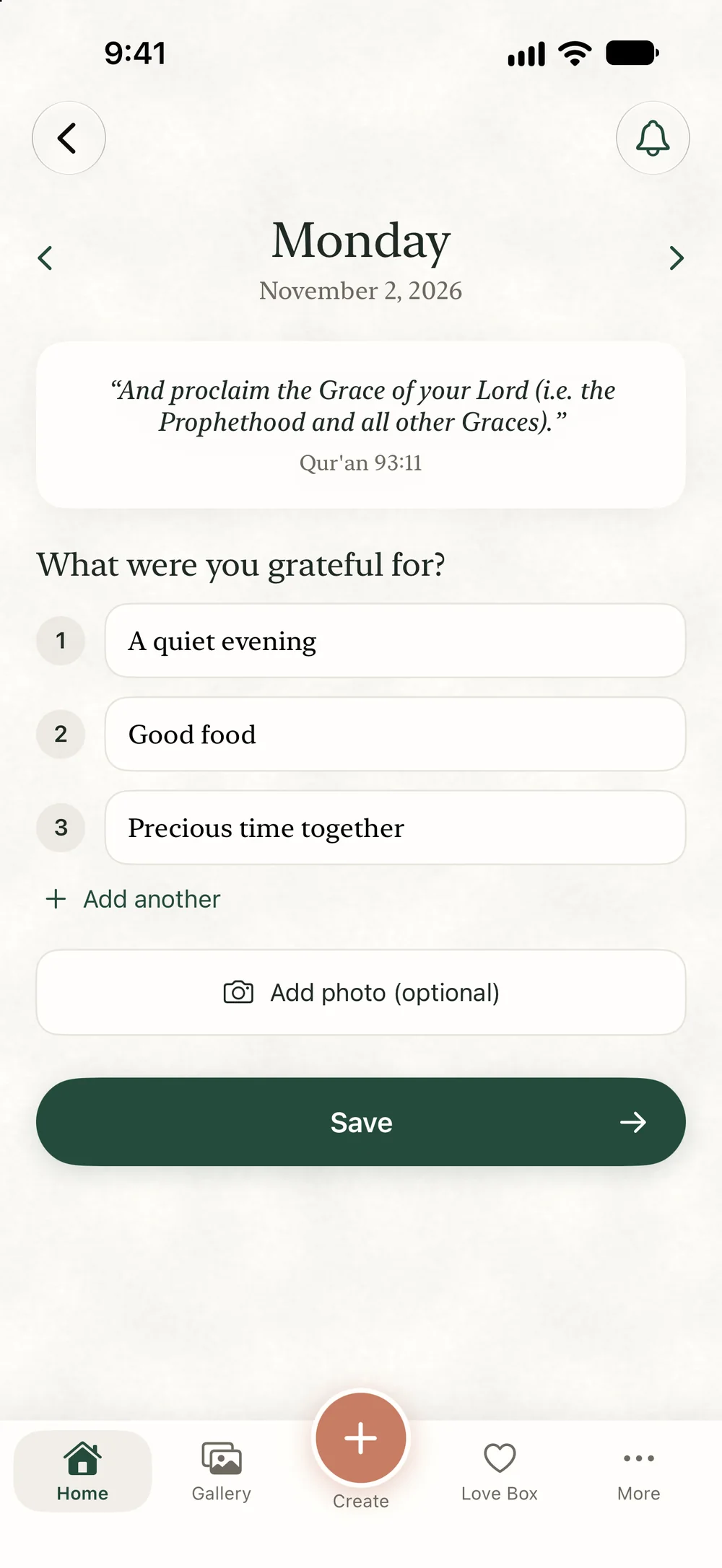
Start with three blessings tonight
Before you sleep, write down three things you were given today and say “Alhamdulillah” for each. Thank one person tomorrow. Then say the dua of refuge and leave the rest to Allah.
Write today’s blessings in Ni’mahFrequently asked questions
- How do I keep the blessings Allah gave me?
- The Qur’an ties keeping blessings to gratitude: “If you are grateful, I will surely increase you [in favor]” (14:7). In practice that means recognising the blessing as coming from Allah, saying “Alhamdulillah”, using it well, thanking the people it came through and asking Allah to protect it.
- What does the Qur’an say about losing blessings?
- Surah al-Anfal 8:53 says Allah would not change a favor He had bestowed upon a people until they change what is within themselves. Surah an-Nahl 16:112 and Surah Saba’ 34:15–17 tell of a town and a people who denied Allah’s favors and lost their safety, provision and gardens.
- Is there a dua to protect blessings?
- Yes. Among the supplications of the Prophet ﷺ was: “Allahumma inni a‘udhu bika min zawali ni‘matika wa tahawwuli ‘afiyatika wa fuja’ati niqmatika wa jami‘i sakhatik” (Sahih Muslim, no. 2739). It asks Allah for refuge from the decline of His blessing and the change of well-being.
- Does losing something mean I was ungrateful?
- This article cannot answer that for any one person, and the verses quoted here are not meant for judging individual cases. The Prophet ﷺ said that the affair of the believer is all good: gratitude in ease and patience in hardship (Sahih Muslim, no. 2999).
- Why does thanking people matter?
- The Prophet ﷺ said that whoever is not grateful to people is not grateful to Allah (Tirmidhi, no. 1954). Many blessings arrive through other people, so thanking them is part of gratitude to Allah.
- Is Ni’mah free?
- Yes, Ni’mah can be used without a subscription: the gratitude journal, reminders, Love Notes, widgets and 1 illustration per month are included. Ni’mah Pro offers a larger illustration allowance; with the yearly plan, two people can use Ni’mah Together.
Sources
- Surah al-Anfal 8:53, Saheeh International (quran.com)
- Surah Ibrahim 14:7, Saheeh International (quran.com)
- Surah an-Nahl 16:112, Saheeh International (quran.com)
- Surah Saba’ 34:15, Saheeh International (quran.com)
- Surah Saba’ 34:16, Saheeh International (quran.com)
- Surah Saba’ 34:17, Saheeh International (quran.com)
- Sahih Muslim, no. 2739 (sunnah.com)
- Sahih Muslim, no. 2999 (sunnah.com)
- Jami‘ at-Tirmidhi, no. 1954 (sunnah.com)
Related guides
- “If You Count the Blessings of Allah”: The Verse and What It Means
“If you should count the favors of Allah, you could not enumerate them”: where the verse is (14:34 and 16:18), what it says and how to notice blessings daily.
- Ni’mah Meaning: What Does Ni‘mah (نعمة) Mean in Islam?
Ni‘mah (نعمة) means blessing, favor or gift. What the Quran says about the blessings of Allah: where they come from, their kinds and how to respond.
- The Health and Free Time Hadith: Two Blessings Many People Lose Out On
The hadith about two blessings many people lose out on, health and free time: its wording, related hadiths and verses, and small ways to use both well.
- “Which of the Favors of Your Lord Will You Deny?” Meaning of Surah ar-Rahman 55:13
Surah ar-Rahman 55:13 in Arabic, transliteration and English: what the verse means, how often it is repeated, who “you both” are and how to answer it.
About the author
Mustafa Ali
Mustafa Ali lives in Medina, the City of the Prophet ﷺ, where he studies Islamic sciences. He built Ni’mah as an Islamic photo app that shows no faces, so families can keep their memories without exposing them to the evil eye and envy.