40 Muslim Journal Prompts for Every Kind of Day
By Mustafa Ali
In short
A Muslim can write about blessings, family, worship, hard days and the duas they are making. Below are 40 prompts in five groups of eight. Pick one a day, answer it in two or three honest sentences and close with a dua.
A Muslim journal can hold anything that helps you look at your day before Allah: the blessings you noticed, the people you love, your prayer and Qur’an, what was hard and what you are asking Allah for. The Qur’an tells every soul to look to what it has put forth for tomorrow (59:18) and to report the favor of its Lord (93:11). The 40 prompts below turn that into one small question a day.
Get Ni’mah on the App Store
What can a Muslim write about in a journal?
There is no set form for a journal in the Qur’an or the Sunnah. It is a tool, and you can use it in whatever way helps you. But the Qur’an does ask for two things a journal is good at: looking honestly at your own day, and mentioning what Allah has given you.
O you who have believed, fear Allāh. And let every soul look to what it has put forth for tomorrow - and fear Allāh. Indeed, Allāh is Aware of what you do.
A few written lines in the evening are one simple way to look at what you put forth today. What did I do with the day? What do I want to bring tomorrow?
But as for the favor of your Lord, report [it].
And [remember] when your Lord proclaimed, ‘If you are grateful, I will surely increase you [in favor]; but if you deny, indeed, My punishment is severe.’
These three verses give a journal its direction: look at yourself, mention the favor, be grateful. The five groups of prompts follow from that. Two of them, hardship and hopes, are there because not every day is an easy one, and a journal should have room for those days too.
How to use the prompts
Pick one prompt, not five.
Choose the one that fits today. On a good day take one from gratitude, on a heavy day one from hardship and patience.
Answer in two or three sentences.
Be specific. “My sister drove forty minutes to bring soup” is worth more than “I am grateful for my family”.
Write for yourself.
Nobody is marking this. Plain, honest words are enough, in whatever language you think in.
Close with a dua.
End the entry by asking Allah for something. The dua at the end of this page is a good one to learn.
Come back to it.
Read old entries once a month. Prompts you answered before can be answered again; the answer will have changed.
40 Muslim journal prompts
Eight prompts each for five parts of life. They are our own wording, meant as starting points. Skip any that does not fit you.
Gratitude
- What did you eat today that someone else cooked, grew or paid for?
- What did you use today that was made or delivered by someone you will never meet?
- Which blessing did you have ten years ago that you still have today?
- What were you able to do today because you had slept, eaten or rested?
- What went better today than you expected this morning?
- Which blessing did you only notice after it was missing for a while?
- When did you say “Alhamdulillah” today, and what was it for?
- If you could keep only five things you own, which would they be?
Family
- What did your mother or father do for you as a child that you only understood later?
- Which saying of a family member do you now hear in your own voice?
- What does your home sound like when everyone is in it?
- Which relative have you not spoken to for a long time, and what would you say first?
- What did someone in your family give up so that you could have something?
- Which family meal do you remember best, and who sat at the table?
- What would you like the younger people in your family to remember about you?
- What is one thing you can do this week to make a family member’s day easier?
Worship and Qur’an
- In which prayer today was your mind most present, and what helped?
- Which verse did you read or hear this week that stayed with you? Write it down with its surah and number.
- Which prayer is hardest for you to pray on time, and what gets in the way?
- What did you ask Allah for in sujud today?
- Which name of Allah did you think about this week, and why that one?
- What small act of worship could you do every day without anyone knowing?
- When did you last read the Qur’an slowly, and what did you notice?
- Which surah do you know by heart that you would like to understand better?
Hardship and patience
- What is weighing on you today? Write it in one plain sentence.
- Which part of this difficulty is in your hands, and which part is not?
- What would you say to a friend who was in your situation?
- Which ease in your life came after a difficulty?
- Where did you stay patient today when it was not easy?
- What did you complain about today, and how would you put it in a dua instead?
- Who could you ask for help this week, and what is holding you back?
- What is one small thing you can still do today, even though the day is hard?
Hopes and duas
- Which three things do you want to ask Allah for this month?
- Whose name will you mention in your dua tonight, and what will you ask for them?
- What do you hope an ordinary day looks like for you one year from now?
- Which habit would you like to have by next Ramadan?
- What do you want to do better tomorrow than you did today?
- Which dua have you been making for a long time? Write it out again today.
- Which good deed of yours do you hope will continue after you?
- What did you put forth today for tomorrow?
The last prompt is taken from the wording of 59:18. It works on any day, which makes it a good one to return to when nothing else comes to mind.
A dua to close your entry
The Prophet ﷺ took Mu‘adh ibn Jabal by the hand, told him that he loved him and advised him never to leave this dua at the end of every prayer. It asks for the three things a journal like this is about: remembering, thanking and worshipping well.
اللَّهُمَّ أَعِنِّي عَلَى ذِكْرِكَ وَشُكْرِكَ وَحُسْنِ عِبَادَتِكَ
Allahumma a‘inni ‘ala dhikrika wa shukrika wa husni ‘ibadatik.
O Allah, help me to remember You, to thank You and to worship You well.
The hadith places this dua after the prayers. If you write after Isha, the two fit together easily: pray, say the dua, then write your few lines.
Paper journal or app?
The prompts work in any notebook. An app is more practical if your phone is always with you: it reminds you each day, keeps your answers in order and lets you add a photo to an entry.
Ni’mah is a Muslim gratitude journal for iPhone that we built for Muslim families. You write down what you are grateful for each day, and a reminder helps you keep the habit. Your memories are stored on your iPhone and, with iCloud sync, in your private iCloud. If you like, a photo becomes an illustration in which faces are not recognizable.
Without a subscription, the gratitude journal, reminders, Love Notes, widgets and 1 illustration per month are included. Ni’mah Pro gives you a larger illustration allowance.
Ni’mah is our own app.
Download Ni’mah on the App Store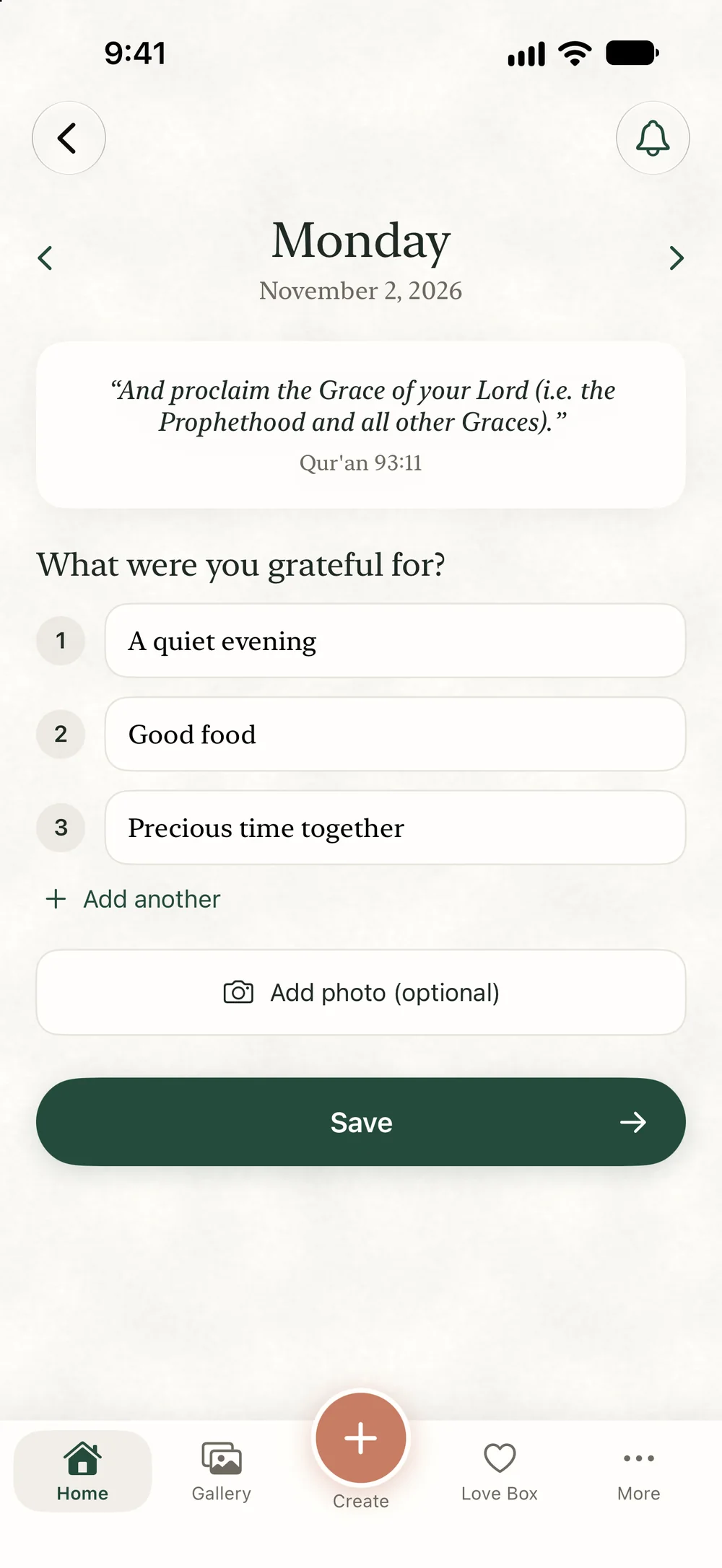
Pick one prompt tonight
Choose a single question from the list, answer it in two or three sentences and close with a dua. Tomorrow, pick another. That is the whole method.
Answer today’s prompt in Ni’mahFrequently asked questions
- What can a Muslim write about in a journal?
- Blessings you noticed, moments with family, your prayer and Qur’an reading, what was hard today and the duas you are making. The 40 prompts on this page cover these five areas with eight questions each.
- Is journaling part of Islam?
- The Qur’an and the Sunnah do not prescribe a journal in any set form. The Qur’an does tell every soul to look to what it has put forth for tomorrow (59:18) and to report the favor of its Lord (93:11). A journal is one way to do both.
- How many prompts should I answer each day?
- One is enough. Two or three honest sentences on a single prompt, written regularly, are more useful than a long entry once a month.
- What should I write on a hard day?
- Take a prompt from the group on hardship and patience, for example: “What is weighing on you today? Write it in one plain sentence.” Then turn it into a dua. A journal entry does not have to be cheerful to be honest.
- Where can I find more gratitude prompts?
- Our guide to the shukr journal has 30 more prompts that focus only on gratitude, together with steps and example entries. None of them are repeated here.
- Is Ni’mah free?
- Yes, Ni’mah can be used without a subscription: the gratitude journal, reminders, Love Notes, widgets and 1 illustration per month are included. Ni’mah Pro offers a larger illustration allowance; with the yearly plan, two people can use Ni’mah Together.
Sources
- Surah Ibrahim 14:7, Saheeh International (quran.com)
- Surah al-Hashr 59:18, Saheeh International (quran.com)
- Surah ad-Duha 93:11, Saheeh International (quran.com)
- Sunan Abi Dawud, no. 1522 (sunnah.com)
Read also
Related guides
- Free Printable Gratitude Journal for Muslims: 30 Days of Shukr (PDF)
Download a free 30-day shukr journal for Muslims as a printable PDF: a prompt for every day, space for three blessings, and duas for gratitude with sources.
- Muhasaba: Meaning and a Gentle Evening Routine
What muhasaba means, the Qur’an verses behind it and a gentle five-minute evening routine with example questions for taking yourself to account.
- Ramadan Journal: How to Keep One and What to Write
How to keep a Ramadan journal in five minutes a day: a simple daily page, 30 short prompts, the dua for Laylat al-Qadr and the verses behind it, with sources.
- Teaching Children Gratitude in Islam
How to teach a child to be grateful to Allah: Luqman’s advice, three small Sunnah habits, ideas by age and a two-minute bedtime routine. With sources.
- Umrah Journal: What to Write Before, During and After the Journey
How to keep an Umrah or Hajj journal: what to write before, during and after the journey, prompts for Makkah and Madinah, and a dua list. With sources.
About the author
Mustafa Ali
Mustafa Ali lives in Medina, the City of the Prophet ﷺ, where he studies Islamic sciences. He built Ni’mah as an Islamic photo app that shows no faces, so families can keep their memories without exposing them to the evil eye and envy.